


Having a volunteer engagement plan that aligns with your nonprofit's mission, values, and goals can increase volunteer retention and convert prospects to brand champions.
Updated: 2/4/2026
Volunteer engagement isn't something that happens accidentally. The organizations that consistently attract enthusiastic volunteers, maintain high retention rates, and convert one-time participants into lifelong advocates all have something in common: they've developed a strategic approach to volunteer engagement that goes far beyond simply filling shifts and sending thank-you emails.
A strategic volunteer engagement plan serves as your roadmap for creating meaningful experiences that align with your organization's mission while meeting the needs and expectations of your volunteers. Without this intentional approach, even the most mission-driven organizations risk losing volunteers to disorganization, poor communication, or simply failing to provide the fulfilling experience that today's volunteers expect.
Why Strategic Volunteer Engagement Matters Now More Than Ever
The volunteer landscape has changed dramatically over time. Today's volunteers have more choices than ever about where to invest their time and energy. They expect seamless registration experiences, clear communication, meaningful work, and tangible evidence of their impact. Organizations that treat volunteer engagement as an afterthought are finding it increasingly difficult to attract and retain the volunteers they need.
Consider this: the estimated value of a volunteer hour has grown to approximately $34.79, according to Independent Sector's latest calculations. When you lose a volunteer who contributed 100 hours annually, you're not just losing a dedicated volunteer; you're losing over $3,400 in value to your organization. Multiply that across several volunteers, and the cost of poor engagement becomes impossible to ignore. But the financial impact tells only part of the story. Disengaged or departing volunteers also take with them their institutional knowledge, relationships, potential donor connections, and the enthusiasm that often inspires others to get involved.
Beyond the immediate costs, the lack of strategic volunteer engagement creates a cycle of constant recruitment. Your staff spends time recruiting new volunteers to replace those who leave, rather than deepening relationships with committed supporters who could take on greater leadership roles, recruit their friends and colleagues, or transition into donors. This constant churn exhausts your team and prevents your volunteer program from reaching its full potential.
A strategic engagement plan changes this dynamic. When you intentionally design experiences that resonate with volunteers, communicate effectively throughout their journey with your organization, and demonstrate the meaningful impact of their contributions, you create the conditions for long-term commitment. Volunteers become advocates who recruit others, donors who support your mission financially, and partners who help you accomplish work that would otherwise be impossible.
Getting Started: Essential Questions to Answer First
Before you can build a volunteer engagement plan, you need clarity on several fundamental questions. Take time to thoughtfully consider these with your team, as the answers will shape every aspect of your strategy.
Start by examining your current state. If you asked a volunteer today about their experience with your organization, what would they say? Would they describe feeling welcomed, valued, and clear about how their work contributes to your mission? Or would they express confusion about logistics, frustration with communication gaps, or uncertainty about whether their efforts make a difference? Understanding your starting point helps you identify the gaps between your current reality and your aspirations.
Next, define what success looks like for your volunteer engagement efforts. What specific goals do you hope to achieve through more strategic volunteer engagement? These goals should extend beyond simply filling volunteer shifts. You might aim to:
- Increase volunteer retention rates by a specific percentage
- Convert more volunteers into financial donors
- Reduce staff time spent on volunteer coordination
- Enable volunteers to take on higher-level responsibilities that currently fall to paid staff
Clear goals give you something concrete to work toward and provide a framework for measuring your progress.
Consider also whether you have organizational buy-in for this work. Strategic volunteer engagement can't be the sole responsibility of one overwhelmed volunteer coordinator. It requires commitment from leadership, alignment with your organization's overall strategic plan, and support from program staff who work with volunteers daily. Without this broader organizational commitment, even the best engagement plan will struggle to succeed.
Finally, think about your return on investment, recognizing that ROI in volunteer engagement extends far beyond financial metrics. Yes, volunteer contributions have economic value, but your ROI might also include increased program capacity, stronger community connections, enhanced organizational reputation, innovation from fresh perspectives, or pipelined development for future board members and major donors.
Understanding Your Volunteer Segments
One of the most common mistakes organizations make is treating all volunteers as a single, homogeneous group. In reality, your volunteers likely fall into several distinct segments, each with different motivations, availability, preferences, and expectations. An engagement plan recognizes these differences and creates tailored approaches for different volunteer segments.
Episodic volunteers participate occasionally, often in response to specific events or campaigns. They might help with your annual fundraising gala, volunteer for a community cleanup day, or assist with holiday food distribution. These volunteers value flexibility and clearly defined, time-limited opportunities. They're often motivated by
- Social connections and volunteering alongside friends or colleagues
- High-visibility events that feel meaningful in the moment
- Opportunities that fit easily into busy schedules
- Variety and new experiences
Your engagement approach for once-a-year volunteers should focus on making participation easy, creating memorable experiences, and providing clear pathways for more in-depth involvement if they're interested.
Regular ongoing volunteers commit to consistent service over extended periods. These might be weekly tutors, monthly food bank sorters, or regular administrative support volunteers. They're often motivated by:
- Relationship building with staff, other volunteers, and those served
- Routine and structure in their lives
- Deep connection to your mission
- The satisfaction of developing expertise and seeing long-term impact
These volunteers need ongoing communication, opportunities for growth and leadership, regular appreciation, and involvement in your organizational community. Your engagement strategy should help them feel like valued team members rather than just extra hands.
Skills-based volunteers offer professional expertise for specific projects. This might include marketing professionals helping with campaign development, IT experts assisting with technology issues, lawyers providing pro bono legal support, or strategic consultants facilitating planning sessions. These volunteers are motivated by using their hard-earned expertise for good, professional development opportunities, making high-impact contributions in a limited time, and sometimes by exploring career transitions to the nonprofit sector. They need well-defined projects with clear scopes, efficient processes that respect their time, and recognition of their professional contributions. Learn more about identifying crucial volunteer skills for your organization.
Corporate volunteers often participate through employer-sponsored volunteer programs. They might come as teams for single-day service projects or as individuals participating in ongoing pro bono programs. Their motivations often include team building and bonding, fulfilling corporate social responsibility goals, employee development, and personal interest in your cause. These volunteers need opportunities that accommodate groups, clear impact metrics for reporting back to employers, professional coordination, and connections to corporate giving programs. Understanding corporate volunteer programs can help you better serve this segment.
Youth and student volunteers participate to fulfill service requirements, explore career interests, build their resumes, or connect with peers around shared values. They're often motivated by resume building and college applications, social connections and friend groups, exploring potential career paths, and a genuine passion for causes they care about. These volunteers need mentorship and guidance, flexible scheduling around school commitments, age-appropriate opportunities, and support in connecting their service to learning and growth.
Each segment requires different recruitment messages, onboarding approaches, communication styles, scheduling flexibility, and recognition strategies. Your strategic engagement plan should address how you'll serve each segment effectively while also identifying opportunities to help volunteers progress from episodic to more committed engagement over time.
Creating Volunteer Personas for Deeper Understanding
Beyond identifying broad segments, develop detailed personas for your ideal volunteers. Personas are semi-fictional representations of specific volunteer types based on real data about your existing volunteers and research into potential volunteers you'd like to attract. These personas help you make strategic decisions about recruitment, communication, opportunity design, and engagement tactics.
Start by gathering data about your current volunteers. Review your volunteer database to understand demographics, participation patterns, and engagement levels. Survey volunteers about their motivations, preferences, challenges, and satisfaction. Interview long-term volunteers and those who've recently departed to understand what keeps people engaged or causes them to leave. Look for patterns in which volunteers stick around, which opportunities have high retention, and which communication approaches get the best response.
Use this information to create three to five distinct personas that represent your key volunteer segments. For each persona, document:
- Demographic information like age range, life stage, employment status, and location
- Motivations for volunteering, such as career development, social connections, personal values, life transitions, or community involvement
- Preferences regarding time commitment, type of work, team versus independent opportunities, communication channels, and level of structure
- Challenges and potential barriers, including time constraints, transportation issues, technological comfort, and competing commitments
For example, one of your personas might be"Career-Building Carla," a 24-year-old recent college graduate working in marketing who volunteers to build professional skills, make career connections, expand her network, and explore nonprofit career options. She prefers evenings and weekends for volunteer work, appreciates skill-based projects over general task work, is highly responsive to email and social media, and values professional recognition she can add to her LinkedIn profile. Her main barriers include budget constraints limiting her availability for opportunities with costs, a busy work schedule requiring notice for planning, and uncertainty about long-term location, as she's open to job opportunities elsewhere.
Creating personas like this helps your team make decisions from the volunteer's perspective. When designing a new opportunity, you can ask, "Would Career-Building Carla find this appealing? Does this opportunity address her needs and overcome her barriers?" This volunteer-centered thinking leads to more effective engagement strategies.
Designing Volunteer Experiences That Engage
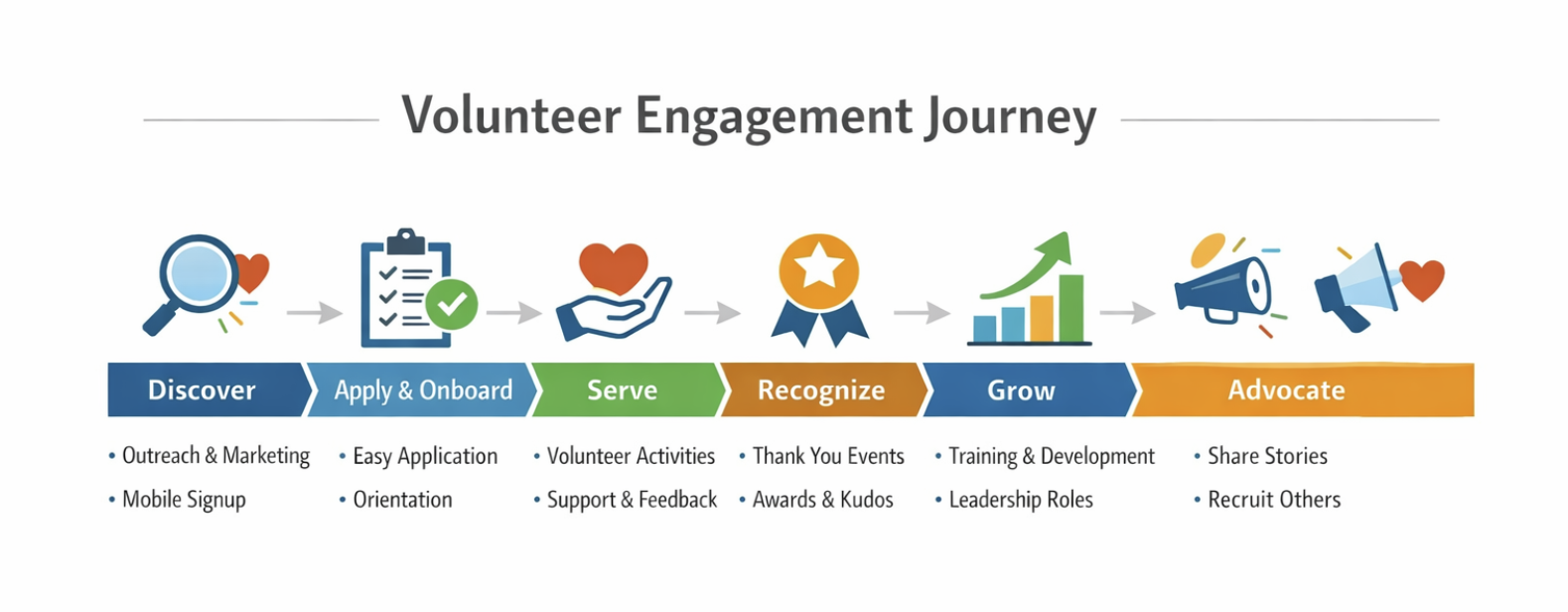
With a clear understanding of your volunteer segments and personas, you can now design experiences that truly engage. Remember that volunteer engagement begins long before someone shows up for their first shift and continues well after they complete their service. Your engagement strategy needs to address every stage of the volunteer journey.
The discovery and recruitment phase is your first opportunity to engage. When potential volunteers encounter your organization, whether through your website, social media, word of mouth, or community events, what impression do they form? Your materials should clearly communicate your mission and impact, make it easy to understand available opportunities, speak to different volunteer motivations, and create excitement about getting involved. Make sure your volunteer webpage is current, mobile-friendly, and prominently featured on your main site. Use compelling stories and images that show real volunteers making a real impact. Consider different recruitment messages for different segments rather than using one-size-fits-all language. For more strategies, explore our guide on volunteer recruitment.
The application and onboarding process sets the tone for the entire volunteer relationship. A cumbersome, outdated process frustrates volunteers before they even begin, while a smooth, welcoming onboarding experience builds confidence and enthusiasm. Use volunteer management software to streamline registration and make the application process mobile-friendly. Communicate promptly after someone registers, setting clear expectations about next steps. Provide a thorough orientation that covers not just logistics but also your mission, impact, and how their specific role contributes. Make sure volunteers know what to expect on their first day and who to contact with questions.
The actual volunteer experience is where engagement truly happens—or fails. Volunteers should feel that their time is valued and well-used, not wasted on unnecessary meetings or disorganized projects. They need to understand how their specific tasks connect to your mission and outcomes. The work should be appropriately challenging, neither overwhelming nor beneath their capabilities. Volunteers should feel welcomed and appreciated, not like outsiders or afterthoughts. They need adequate support and supervision without feeling micromanaged. Creating high-quality volunteer experiences requires planning, clear role descriptions, trained staff and volunteer leaders, and ongoing attention to the volunteer perspective. Our article on creating experiences volunteers will love offers additional insights.
Recognition and appreciation often get reduced to perfunctory thank-you emails, but strategic recognition does much more. It reinforces the volunteer's connection to your mission, acknowledges the specific value of their contribution, and makes them feel seen as individuals rather than free labor. Recognition can take many forms, including personal thank-you notes that reference specific contributions, public acknowledgment at events or on social media, milestone celebrations for long-term volunteers, opportunities for additional responsibility or leadership, invitations to special events or behind-the-scenes experiences, and impact reports showing the outcomes they helped create. The most effective recognition is timely, specific, and authentic. For creative ideas, see our post on volunteer recognition strategies.
Communication Keeps Volunteers Connected
Ongoing communication keeps volunteers connected to your mission and informed about how they can stay involved. Too many organizations only contact volunteers when they need something, creating a transactional feeling that undermines engagement. Instead, maintain regular communication that provides updates on organizational impact and progress, shares stories of how volunteer contributions make a difference, offers diverse opportunities for continued involvement, asks for volunteer input and feedback, and recognizes volunteer achievements and milestones. Use multiple communication channels to reach volunteers where they are, including email newsletters, text messages for time-sensitive updates, social media for community building, and your volunteer portal for scheduling and tracking. Learn more about effective communication strategies for volunteer retention.
Feedback and growth opportunities signal to volunteers that they're valued team members whose opinions matter. Regularly solicit feedback through brief post-event surveys, annual volunteer satisfaction surveys, one-on-one conversations with long-term volunteers, and focus groups for program planning. Then, actually use this feedback to make improvements and close the loop by telling volunteers what you learned and what you're changing based on their input. Provide pathways for volunteers to grow within your program through leadership opportunities, mentorship roles, specialized training, and committee or advisory service.
Leveraging Technology for Better Engagement
Strategic volunteer engagement at scale requires the right technology infrastructure. Manual processes using spreadsheets and email lists might work when you have a dozen volunteers and monthly opportunities, but they quickly become unsustainable as your program grows. More importantly, they limit your ability to provide the seamless, responsive experience that volunteers expect.
Volunteer management software serves as the foundation for strategic engagement because it enables you to:
- Streamline registration and scheduling so volunteers can easily sign up for opportunities that interest them
- Track volunteer hours, activities, and engagement patterns to understand what's working
- Automate routine communications while maintaining personalization
- Generate reports and analytics that demonstrate impact and inform strategy
- Create customized volunteer portals where individuals can see their history and discover new opportunities
- Segment your volunteer base for targeted outreach based on interests, skills, or engagement level
Beyond basic volunteer management, consider how other technologies can enhance engagement. Email marketing platforms integrated with your volunteer system enable sophisticated communication campaigns. Text messaging reaches volunteers instantly with time-sensitive updates and reminders. Social media creates community and amplifies volunteer recruitment through sharing. Mobile apps allow volunteers to access information, check in, and log hours from their phones. Online training platforms enable volunteers to complete orientation and skill-building at their own pace.
The key is choosing technology that actually improves the volunteer experience rather than simply making internal processes easier. Before adopting any new tool, ask whether it will make volunteering more convenient, more rewarding, or more impactful from the volunteer's perspective. If the answer is no, the technology probably isn't worth the investment.
Measuring Engagement and Adjusting Your Approach
A strategic plan without measurement is just wishful thinking. You need concrete metrics to understand whether your engagement efforts are working and where you need to adjust your approach. Start by identifying key performance indicators that align with your engagement goals.
Retention metrics tell you whether volunteers are sticking around. Track:
- Overall volunteer retention rate from year to year
- Retention rates by volunteer segment or opportunity type
- Average volunteer tenure
- Percentage of first-time volunteers who return for a second opportunity
Significant improvements in these metrics indicate your engagement strategies are resonating.
Participation metrics show how actively volunteers are involved. Monitor the number of volunteer opportunities per volunteer per year, average hours contributed per volunteer, percentage of registered volunteers who are active in a given period, and growth in volunteer hours year over year. These metrics help you understand whether you're deepening engagement or simply maintaining surface-level participation.
Quality metrics assess the volunteer experience and your program's effectiveness. Regularly measure:
- Volunteer satisfaction scores from surveys
- Volunteer net promoter scores measuring the likelihood to recommend your program
- Completion rates for volunteer orientations and training
- Percentage of volunteers who respond to surveys or other feedback requests
- Staff satisfaction with volunteer support
These indicators help you identify problems before they lead to widespread volunteer departures.
Impact metrics demonstrate the value volunteers create. Calculate the estimated economic value of volunteer hours, outcomes achieved with volunteer support compared to goals, qualitative stories and testimonials about volunteer impact, volunteer-to-donor conversion rates, and volunteer recruitment through word-of-mouth referrals. These metrics help you communicate the importance of volunteer engagement to leadership and funders.
Establish a regular rhythm for reviewing your metrics and adjusting your strategy accordingly. Monthly reviews of basic participation and registration data help you spot emerging trends. Quarterly deep dives into retention, satisfaction, and engagement patterns inform tactical adjustments. Annual comprehensive evaluations compare year-over-year progress and guide strategic planning for the coming year. Our guide on measuring volunteer impact provides additional frameworks for evaluation.
Building Organizational Capacity for Engagement
Even the best strategic plan will fail without adequate organizational capacity to execute it. Sustainable volunteer engagement requires appropriate staffing, clear roles and responsibilities, supportive leadership, and integration with your organization's broader strategy.
Many organizations dramatically underinvest in volunteer program staffing. They assign volunteer coordination to someone already handling other significant responsibilities, or they expect one person to manage hundreds of volunteers across multiple programs with no support. This approach inevitably leads to burnout, poor volunteer experiences, and unrealized potential. Consider whether your current staffing model provides adequate capacity for the engagement strategies you've identified as important. If not, you may need to make the case for additional resources or identify technology and process improvements that can increase efficiency.
Clear roles and responsibilities prevent the diffusion of accountability that often plagues volunteer programs. Your strategic plans should specify who is responsible for:
- Volunteer recruitment and marketing
- Application processing and background checks
- Orientation and onboarding
- Ongoing training and development
- Volunteer recognition and appreciation
- Volunteer data management and reporting
- Relationship management with key volunteers
Make sure program staff who work directly with volunteers understand their role in the engagement strategy and receive any training they need to work effectively with volunteers.
Leadership support extends beyond simply approving your volunteer program. Executives and board members should understand the strategic value of volunteer engagement and actively champion the program. They can support engagement by participating in volunteer recognition events, sharing volunteer stories in external communications, ensuring adequate resources for volunteer program staffing and technology, including volunteer program goals in organizational strategic planning, and recognizing staff members who excel at volunteer engagement.
Integration with broader organizational strategy ensures volunteer engagement doesn't exist in a silo. Your volunteer engagement plans should align with your overall strategic plan, support programmatic goals and priorities, connect with fundraising and donor development strategies, and reflect your organizational values and culture. When volunteer engagement is truly strategic, it becomes a lever for advancing your entire mission rather than just another program to manage.
Moving Forward: Creating Your Plan
With all this context, you're ready to build your strategic volunteer engagement plan. Start by documenting your current state through data review, volunteer surveys, interviews, and staff input about challenges and opportunities. Define your vision and goals for what you want volunteer engagement to look like in one year, three years, and five years. Identify your priority volunteer segments and create detailed personas. Map the volunteer journey and identify specific engagement strategies for each stage.
Develop an implementation timeline that specifies what you'll tackle first based on impact potential and feasibility. Assign responsibility for each component of the plan. Identify required resources, including staffing, technology, budget, and training. Establish your measurement framework with specific KPIs and reporting schedules.
Document your plan in writing so it can guide decision-making and maintain consistency even as staff turn over. Share it broadly within your organization so everyone understands their role in volunteer engagement. Review and update it regularly as you learn what works and as your organizational needs evolve.
Remember that creating a strategic volunteer engagement plan is not a one-time project but an ongoing commitment to continuous improvement. The organizations with the most engaged, committed volunteers didn't achieve that overnight. They invested time in understanding their volunteers, intentionally designed better experiences, measured their results, and kept refining their approach. Your organization can do the same.