

Coordinator turnover is one of the most predictable disruptions in nonprofit volunteer management. Most organizations have already navigated at least one transition, and most will navigate another. What continues to catch programs off guard is not the departure itself, but the scope of what leaves with the person.
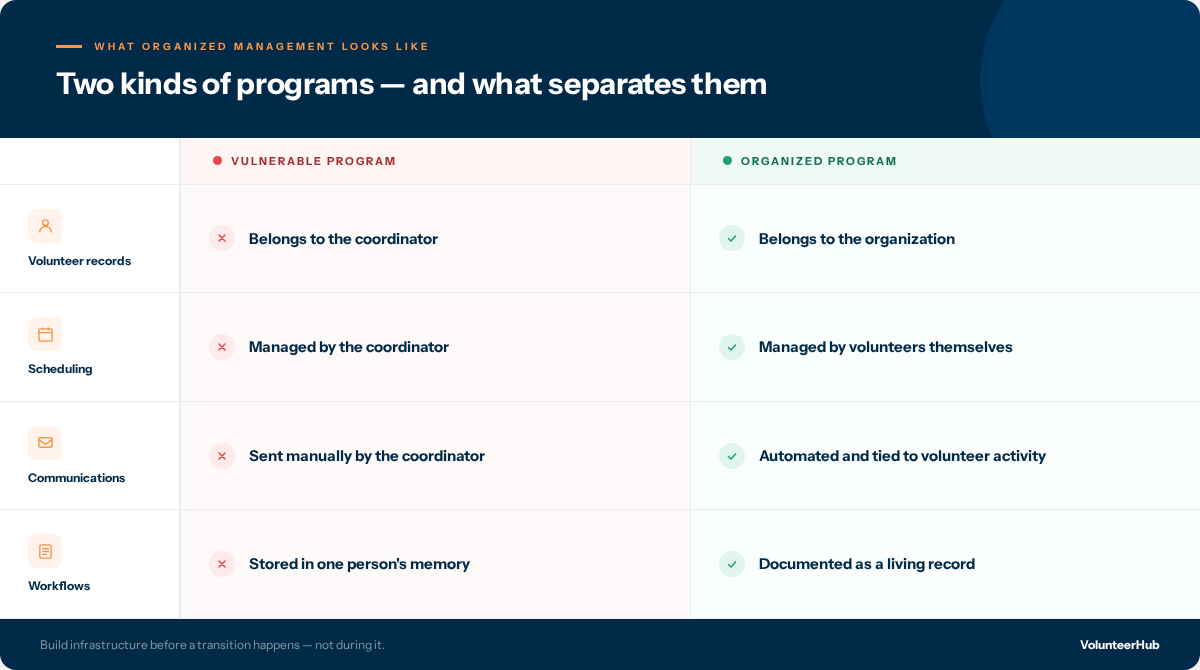
The visible assets remain: job descriptions, orientation materials, policy handbooks. What does not transfer is the operational knowledge that accumulates over months and years in the role. The scheduling workarounds compensate for a particular platform’s limitations. The volunteers who need extra follow-up before a shift, and those who prefer more independence. The judgment calls about which events to prioritize when capacity is tight. The institutional context that turns a capable new hire into a confident, effective coordinator.
None of that lives in a shared, accessible system unless you design it that way. When it stays in one person’s head or inbox, even a well-run program can lose significant ground before a replacement finds their footing.
The Cost of Undocumented Systems
Coordinator transitions are costly even when they appear to go well. Recruiting and onboarding a new coordinator requires significant time and attention from your team. The learning curve is steep when institutional knowledge has not been captured in a shared system. Volunteers notice this instability, and for some, it becomes a reason to step back or disengage.
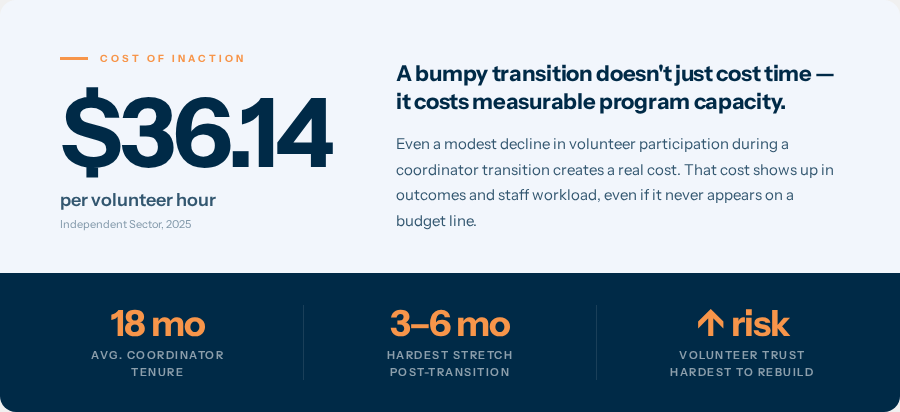
Coordinators we speak with often describe the first three to six months after a transition as some of the most challenging their programs face. The issue is rarely that the new hire is unqualified. The challenge is that the program was operating on informal knowledge that no one had written down or built into a platform, and turning that knowledge into clear, repeatable workflows while also maintaining full program operations is exceptionally difficult.
At $36.14 per volunteer hour (Independent Sector, 2025), even a modest decline in volunteer participation during a bumpy transition creates a real cost to program capacity. That cost shows up in outcomes and staff workload, even if it never appears on a budget line.
There is a second risk that is harder to measure but just as important: volunteer trust. When volunteers sense that the program is disorganized during a leadership transition, some will quietly reduce their commitment or stop showing up. Rebuilding that trust and consistency takes longer than recruiting new volunteers to replace them, which is why investing in systems that preserve continuity matters so much.
What Makes a Program Vulnerable
Most programs that struggle during coordinator transitions share a common structural vulnerability: over time, the coordinator has effectively become the system.
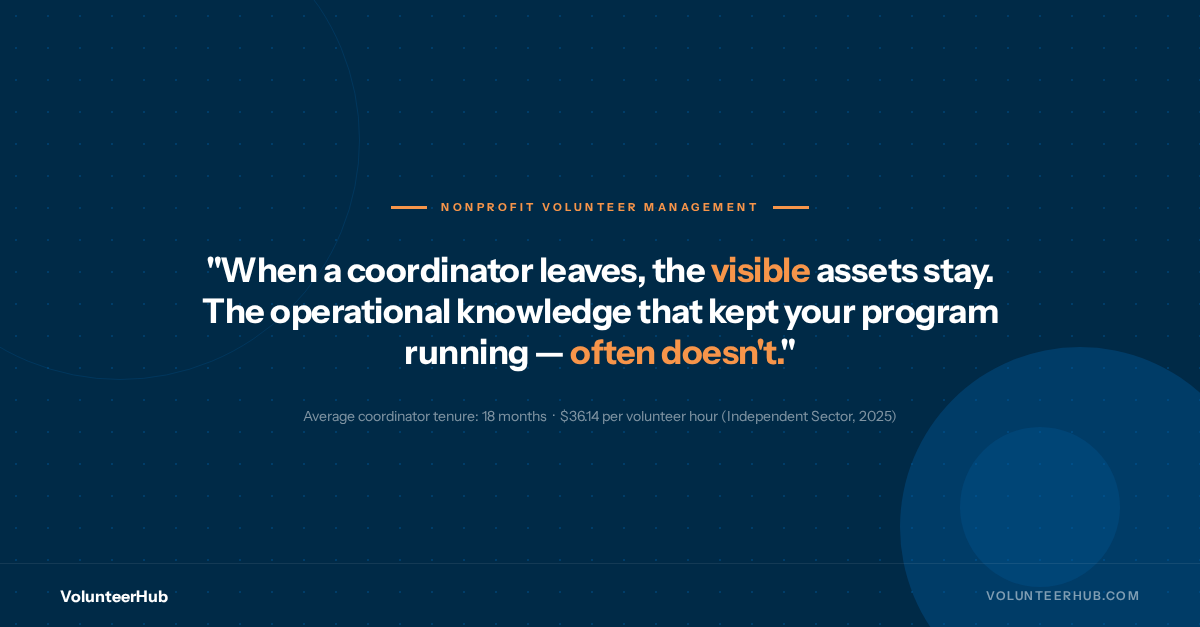
Scheduling lives in a spreadsheet that only they maintain. Communications go out from their individual work email. Volunteer preferences, history, and notes reside in their memory or on local files that do not transfer with the role. Check-in is guided by a process they have refined over time but never fully documented.
This is not a failure of discipline or organization. It is the predictable outcome of a role that is chronically under-resourced and expected to deliver results without sufficient administrative infrastructure. Coordinators build what they need to keep the program moving. When no shared platform exists to hold institutional knowledge, that knowledge naturally accumulates in the person instead.
A helpful diagnostic question is this: if your current coordinator were unavailable for two weeks starting tomorrow, how much of your program would still run as expected? Which activities depend on that specific individual, and which would continue smoothly regardless of who is in the role?
For many organizations, an honest answer reveals a level of dependency on a single person that leadership has not fully recognized—highlighting both a risk and an opportunity to build more resilient systems.
What Organized Volunteer Management Looks Like
Programs that weather coordinator transitions well tend to be built on systems rather than individual knowledge. That requires building specific infrastructure before a transition happens, not during it.
A few things that separate resilient programs from vulnerable ones:
Volunteer records that belong to the organization, not the coordinator. Every volunteer's history, preferences, notes, hours, and contact information should live in a platform that any authorized staff member can access. When that data lives in a coordinator's spreadsheet or inbox, it is functionally inaccessible to anyone else. A centralized volunteer database means the knowledge transfers with the role, not the person.
Scheduling that volunteers manage themselves. When volunteers can sign up, swap shifts, and manage their own availability through a self-service system, the coordinator's involvement in day-to-day scheduling drops significantly. The program does not grind to a halt during a transition because volunteers are not waiting for a coordinator to take action. Volunteer self-scheduling reduces the single point of failure that most programs do not recognize until a transition forces the issue.
Automated communications that run without manual intervention. Confirmation emails, reminders, follow-up messages, and thank-you notes should not depend on a coordinator remembering to send them. When communications are automated and tied to volunteer activity, they continue through a transition without any additional effort from an interim or incoming coordinator.
Documented workflows that a new person can follow. This is the one that organizations consistently underinvest in until a transition forces the issue. A clear, written account of how your program actually runs, including the informal workarounds and the judgment calls, is the most direct form of institutional knowledge transfer available. It is also the hardest to create after the fact. The organizations that do this well treat it as a living document that the coordinator updates regularly, not a one-time project before their last day.
The Compounding Problem
One dimension of coordinator turnover that is frequently overlooked: the same conditions that make a program vulnerable during a transition are usually the same conditions that caused the turnover in the first place.
Coordinators who are manually rebuilding schedules each week, sending every communication by hand, and carrying the full weight of volunteer relationship management in their heads burn out faster. The average coordinator tenure across the programs we work with is approximately 18 months. That is not long enough to build deep institutional knowledge before the cycle starts again.
The answer to coordinator turnover and to the knowledge-loss problem is the same: build systems that carry institutional knowledge at the platform level rather than the person level. Addressing coordinator turnover before it happens reduces both the frequency of transitions and the damage each one does.
This also means that building this infrastructure makes the current coordinator's job easier, which extends their tenure. Reduced manual load, more visibility into program health, and less dependence on memory and improvisation are things coordinators notice and value.
The Starting Point
You do not need to rebuild your entire program to reduce its vulnerability to turnover. Start by identifying the three things your coordinator does that no one else could currently handle without significant ramp-up time.
Those three things are your risk inventory. For each one, ask what it would take to move that knowledge from the coordinator's head into a system that any authorized person could use.
In most programs, that question points toward the same set of answers: centralized volunteer records, self-service scheduling, automated communications, and documented workflows. Optimizing your scheduling process is often the most immediate place to start, because scheduling is usually where the most informal institutional knowledge accumulates.
VolunteerHub helps organizations recruit, engage, and manage volunteers in a way that holds program knowledge at the system level, not the individual level. If your program is approaching a transition, or if you want to build more resilience before one happens, we would be glad to talk through what that looks like for your program and system.