


In a large volunteer program, the cost of a single point of failure rarely stays contained to one shift or one site.
For example, if a specialized role goes unfilled at one regional site, it can disrupt an entire program rotation. If a long-time lead volunteer leaves and no successor has been prepared, a multi-site initiative may lose momentum for months. And when only one volunteer knows how to complete a critical task, that task becomes a continuity risk that grows as the program expands.
That is why large volunteer programs need to build a second layer of capability before disruption happens. But in many organizations, this work is not treated as an ongoing program function. Even in large nonprofits, where the impact of staffing gaps is easier to see, cross-training is often handled informally by individual coordinators. Each coordinator may do their best with limited time, but without shared standards, the approach can vary widely across sites and programs.
The framework below offers a practical way to build bench depth at the program level. It is designed to be useful for coordinators and clear enough for leadership to understand. It is process-based and platform-agnostic, but it scales best when your volunteer management system supports clearly defined roles, recurring shifts, multi-site administration, and program-level reporting.
Why Large Volunteer Programs Need a Cross-Training Plan
Recruitment and retention are usually visible at the program or organizational level. Bench depth rarely is.
Coverage gaps most often surface only after a disruption has already occurred — in incident reports, urgent staffing conversations, or post-mortem reviews. By that point, coordinators are working in crisis response mode instead of carrying out a planned continuity strategy that could have been measured and managed in advance.
In a large nonprofit, several factors make redundancy gaps more costly:
Program interdependence.
A specialized volunteer role at one site may support operations at nearby or affiliated sites. When that role is uncovered, the impact can spread across a region.
Concentration of knowledge among senior volunteers.
Long-tenured volunteers often carry important knowledge that has never been formally documented. This may include partner relationships, compliance steps, specialized equipment, or internal systems.
Coordinator turnover.
Large programs often rely on multiple coordinators. When a coordinator leaves, their informal knowledge of which volunteers can cover key roles often leaves with them.
Audit and governance expectations.
Boards, funders, and major donors increasingly want to see evidence of operational continuity planning. A documented bench is easy to report on. An undocumented one is much harder to defend.
As a volunteer operation grows, cross-training shifts from a helpful local tactic to a core program responsibility. Directors and coordinators need clear visibility into where coverage risks exist, which roles rely too heavily on a single person, and whether each site has enough trained, current volunteers to sustain services when disruptions occur.
Defining bench depth in a large-program context
Bench depth is the number of trained, current, and willing volunteers who can step into a specific role with minimal supervision when the regular volunteer is unavailable.
In a large nonprofit, bench depth also needs to be understood across sites and programs.
Cross-site coverage means a volunteer trained for a role at one location may be able to cover a similar role at another affiliated location, as long as the role is defined consistently.
Cross-program coverage applies when the same specialized role appears across multiple programs. Examples may include registration, intake, compliance verification, or equipment operation. When these roles are documented in a consistent way, volunteers can be trained to support more than one program.
These coverage options are difficult to manage informally. They become much easier to track when role definitions, qualifications, and training status are maintained in one system of record.
A six-step framework
This framework is designed to be repeated each quarter as a program-level practice.
For a large volunteer program, the first rollout will usually require coordinated work between the director of volunteer services and individual coordinators.
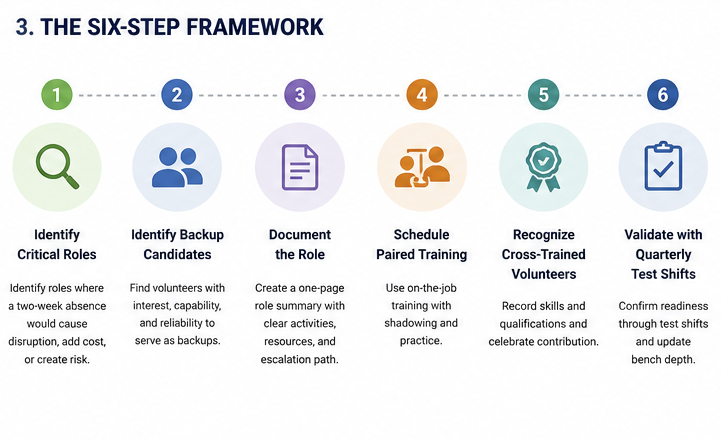
Identify critical roles across the program
The starting point is roles rather than individuals, evaluated at the program level rather than the shift level.
For each program area, identify functions whose two-week absence would either disrupt service delivery, shift workload to already-stretched paid staff, or create reporting exposure with funders or governance bodies. Across a large nonprofit, this typically produces a consolidated list of twenty-five to sixty roles, organized by program and site.
The list should be reviewed for category overlap. Roles performing similar functions across sites — registration, intake, orientation facilitation, equipment operation — should be flagged as candidates for standardized role definitions and shared bench planning.
Identify candidate volunteers for each role
For each critical role, identify volunteers who could plausibly serve as a backup. The qualification threshold is consistent regardless of program size:
- Demonstrated interest in the work
- Existing skill or the capacity to develop it within several shifts
- A documented track record of reliability
In large programs, this step benefits from program-wide visibility. Volunteers active in one program may be qualified candidates for backup roles in adjacent programs, particularly where role definitions have been standardized.
Once candidates are identified, formal outreach should be coordinated through the volunteer's primary program contact. A development conversation initiated by a coordinator the volunteer already knows lands more effectively than one initiated by an unfamiliar program manager.
Document each role on a single page, with program-wide consistency
A one-page role summary that an experienced volunteer can use the first time they cover a shift is the working unit of documentation. At scale, the goal is not only that each role has a summary, but that summaries across the program follow a consistent structure.
A standardized one-page summary includes:
- Role name, program context, and site applicability
- Core activities, listed in operational sequence
- Decision authority — actions taken independently versus those requiring escalation
- Locations of materials, codes, contact information, and physical resources
- Escalation path if an unexpected situation occurs
- Trainer of record and the qualifications they certify
Programs that adopt a shared role-summary template across departments report meaningfully lower maintenance overhead than programs in which each coordinator develops their own format. Consistency also improves cross-site portability.
Schedule paired training shifts as a program-wide practice
The most efficient mechanism for developing a backup is to assign the trainee and the primary volunteer to the same shift, with the trainee operating the role and the primary providing oversight.
For routine roles, two to three paired shifts are generally sufficient. For roles involving specialized systems, regulated activities, or partner-facing responsibilities, five to seven may be required. These shifts should be incorporated into the standard schedule rather than treated as discrete training events.
In a large program, scheduling tools that support recurring shifts, multiple-volunteer assignments to a single role, and trainee status tagging allow paired training to be administered consistently across sites without parallel processes per coordinator.
Recognize the cross-trained as a defined program contribution
A cross-trained volunteer represents a higher-value contribution to program resilience than one who covers only their primary role. Recognition should reflect this distinction and should be administered consistently across the organization.
Practical options include adding a notation in the volunteer record, highlighting cross-trained volunteers in program communications, securing recognition from senior leadership, and including this contribution in established recognition programs. When recognition criteria for backup readiness are standardized across programs, volunteers experience a clear and consistent message that this work is valued, which helps sustain the practice over time.
Validate the bench through scheduled quarterly test shifts
A bench that has not been tested in live program conditions is not yet confirmed.
Setting a program-level standard of one quarterly test shift per critical role creates a consistent way to validate readiness across sites. During each test shift, the primary volunteer is intentionally scheduled off, and the cross-trained volunteer runs the role independently. A brief debrief afterward captures what worked as expected, what felt unclear or undocumented, and what updates the role summary needs.
When you aggregate these test-shift results across the program, you gain clear visibility into which roles have verified bench depth and which still need development. This becomes a practical reporting layer for demonstrating operational continuity to boards, funders, and other governance stakeholders.
How VolunteerHub supports the framework at scale
The framework can be implemented without dedicated volunteer management software. At the scale of a large nonprofit — with multiple sites, programs, and coordinator teams — implementation is meaningfully more efficient when the underlying system supports cross-program administration and reporting.
Programs using VolunteerHub at scale typically apply:
- User Groups to define qualified volunteers by role across programs and sites, making the eligible backup pool visible at the program level.
- Configurable Forms at registration and renewal to capture interest in backup, development, and cross-site roles.
- Multi-Event Editor and recurring shifts to schedule paired training within the standard program rhythm.
- Group Manager and Advanced Permissions to allow regional or program-level administrators to manage their own bench while preserving organization-wide visibility.
- Custom Reports to identify roles where bench depth remains thin and to support board-level reporting on operational continuity.
- Workflows to automate reminders to cross-trained volunteers ahead of scheduled test shifts.
- Landing Pages to maintain distinct sign-up paths per program or site while consolidating cross-trained volunteer data into one operational view.
These capabilities do not constitute the framework. They reduce the operational cost of sustaining it across a large and distributed program.
A practical starting point
Start by creating a critical-role inventory across all program areas.
Use one shared definition of a “critical role”: any role where a two-week absence would disrupt services, require paid staff to step in, or create governance or compliance risk.
This inventory becomes the working list for the rest of the framework.
For organizations that have not done this before, the inventory often reveals coverage gaps that were not visible at the program level. Finding those gaps early gives you time to address them thoughtfully, instead of trying to solve them during a disruption.
VolunteerHub provides volunteer management software for nonprofits running large, multi-site volunteer operations, with tools for cross-program administration, hour tracking, and reporting on operational continuity. Connect with our team to explore how the platform can support your program’s specific operational and reporting needs.