

Your most loyal donors often start as volunteers, but the path from first shift to first gift isn’t automatic. It’s a journey you can map, measure, and support.
Your most committed financial supporters rarely begin their journey by making a gift. They begin by showing up. Research consistently demonstrates a strong overlap between volunteers and donors, and understanding why that connection exists is essential to unlocking your volunteer program’s full fundraising potential.
Volunteers sign up for an event, complete their first shift, and experience your mission in action. Over time, their involvement deepens. They return. They take on more responsibility. Eventually, they become so personally invested in the outcomes that giving financially feels like a natural extension of their commitment — not an unexpected request.
This volunteer-to-donor journey is not accidental. It often follows a pattern that organizations can map, support with intentional engagement practices, and monitor with data. When you understand the stages a volunteer moves through on the way to becoming a donor, you can design your program to nurture that progression with purpose, rather than hoping it happens on its own.
This framework was developed for a recent VolunteerHub and Omatic webinar on turning volunteer hours into donor dollars. If you missed it, the recording is worth a watch.
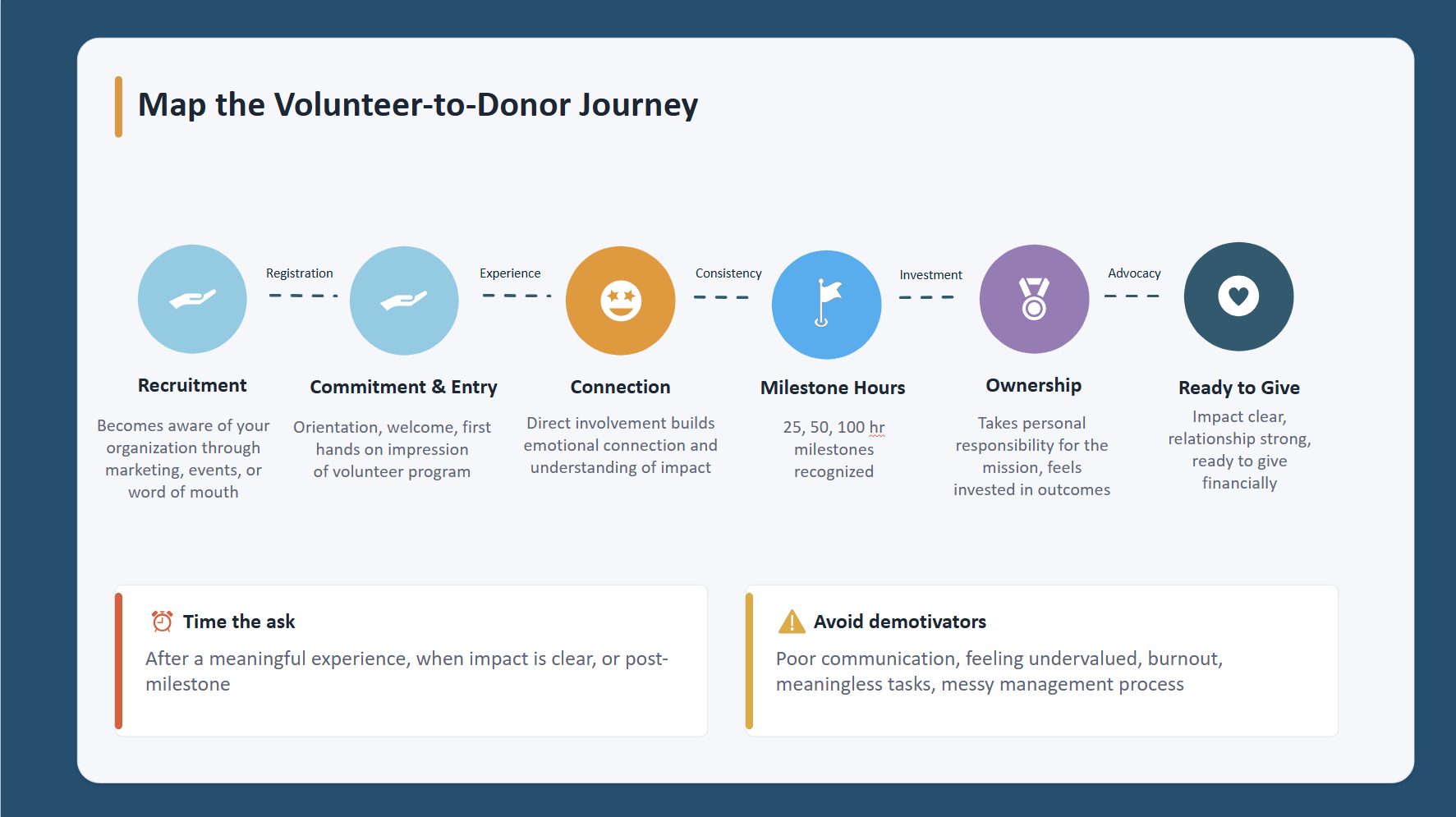
The Six Stages of the Volunteer-to-Donor Journey
Volunteer Recruitment
The volunteer becomes aware of your organization.
This is the top of your volunteer funnel. A potential volunteer discovers your organization through your website, marketing, community events, referrals, social media, corporate partnerships, or other outreach. At this stage, they’re aware of who you are—but haven’t yet decided to invest their time.
What matters here isn’t just how many people you reach, but the strength of that first impression. Does your volunteer landing page clearly communicate what the experience will be like and why it matters? Is the registration process simple enough for a first-time visitor to sign up in just a few minutes?
The clearer your value and the easier it is to say yes, the more people will move from awareness to registration to action.
Commitment and Entry
The volunteer registers, completes orientation, and has their first hands-on experience.
This is where the relationship begins. The volunteer creates an account, goes through onboarding or orientation, and shows up for their first shift. Every part of this stage should communicate that your organization is organized, welcoming, and values their time.
First impressions here set the trajectory for everything that follows. A smooth registration, warm welcome, and clear sense of purpose during the first shift signal that they’ve made a good decision. A disorganized check-in, unclear expectations, or feeling underutilized does the opposite.
** To optimize this stage, review your onboarding workflow from the volunteer’s perspective. How many steps are between “I want to help” and “I’m actually helping”? Every unnecessary step increases the risk of dropout.
Connection to Cause
Direct involvement builds emotional connection and understanding of impact.
This is where something shifts, and where many organizations lose people. Only about65% of volunteers make it from the commitment stage to the connection stage. That drop-off between the first and second shift isn’t just a retention problem. Volunteers give, on average, 10 times more than non-volunteers. Every volunteer who disengages before reaching connection is potentially a future donor walking out the door.
Connection is where a volunteer begins to feel part of something meaningful. It’s the food bank volunteer seeing a family’s relief. The tutor watches a student’s confidence grow. The animal shelter volunteer sees a dog they’ve walked get adopted.
This emotional connection is the engine of the entire journey. Without it, volunteering stays transactional—a shift completed, then forgotten. With it, volunteers become personally invested in outcomes, driving long-term retention and donor conversion.
Milestone Hours
Consistent participation is recognized and reinforced.
As volunteers return again and again, hitting 25, 50, 100-hour milestones, their commitment deepens. They're no longer trying out your organization. They're part of it.
Recognizing these milestones matters more than most organizations realize. A simple acknowledgment — an email, a certificate, a mention at an event — tells the volunteer that their consistency is noticed and valued. It reinforces the behavior you want to see and strengthens the emotional bond that's been building,
Need ideas? Here are 9 proven ways to boost volunteer morale.
Milestone recognition also creates natural touchpoints for deeper engagement. A volunteer who just crossed 100 hours is far more receptive to a conversation about leadership roles, committee involvement, or eventually, financial support than someone who signed up last week.
Define your milestone thresholds and plan a recognition touchpoint for each one. It doesn't need to be elaborate; consistency and sincerity matter more than cost.
Ownership
The volunteer takes personal responsibility for the mission and feels invested in outcomes.
At this stage, the volunteer has shifted from participant to stakeholder. They do not just arrive when scheduled — they care deeply about whether the program succeeds. They invite friends to get involved. They offer thoughtful feedback. They think about the organization’s challenges as if they were their own.
This sense of ownership is one of the strongest predictors of donor conversion. A volunteer who feels personally responsible for outcomes has already made a significant emotional investment. A financial contribution becomes a natural extension of that commitment, rather than a separate or unexpected request.
You can see ownership emerging in behavior: volunteers who increase their event frequency without prompting, who engage across multiple program areas beyond their initial role.
Ready to Give
Impact is clear, the relationship is strong, and the volunteer is ready to give financially.
This is the stage many organizations want to reach as quickly as possible, but it is only effective when the ask is made at the right time. A volunteer who has experienced your mission firsthand, built an emotional connection, demonstrated consistent commitment, and taken ownership of outcomes is fundamentally different from the connection a new volunteer has with your org.
They do not need to be persuaded that your organization creates impact; they have seen it. They do not need to be reassured that their donation will be used well; they have watched your work from the inside. In this context, the ask is not pressure or persuasion; it is an invitation to deepen a commitment they have already chosen to make.
Where VolunteerHub Fits in the Journey
The volunteer-to-donor journey depends on your team’s ability to build real relationships with volunteers. That’s what moves someone from showing up to feeling connected—and eventually becoming a donor.
But it’s hard to build those relationships when your team is stuck managing spreadsheets, registrations, and schedules. The more time spent on logistics, the less time there is for meaningful interaction.
That’s where VolunteerHub helps.
- Recruitment → Make it easy to say yes
Branded landing pages and online registration give volunteers a clear, low-friction way to get started when they discover your organization. - Commitment & Entry → Create a smooth first experience
Online scheduling and waivers reduce confusion and help volunteers move smoothly from interest to their first shift—supporting a stronger onboarding experience. - Connection → Keep volunteers coming back
Automated reminders and targeted communication help maintain momentum after the first experience. - Engagement & Milestones → Reinforce commitment
Hour tracking and reporting make it easy to recognize milestones and consistently acknowledge volunteer contributions. - Ownership → Personalize the experience
User groups allow you to segment by interests, skills, and activity, so you can offer more relevant opportunities and deepen involvement. - Ready to Give → Connect volunteer data to donor strategy
CRM integrations give your development team visibility into volunteer history, making it easier to identify highly engaged supporters and reach out at the right time.
If you're interested in connecting VolunteerHub to your donor database, learn more about Omatic here.
By simplifying the administrative work, VolunteerHub gives your team more time to focus on what matters most: building relationships that turn volunteers into long-term supporters.