
What food bank leaders need to know about selecting volunteer management software, from key features to vendor evaluation.
More than half of all nonprofit food programs are run entirely by volunteers, and even those with paid staff depend on volunteers for the work that actually moves food, such as sorting donations, packing boxes, staffing mobile pantries, and stocking partner agency shelves. If you are the coordinator behind that work, your week is shaped by how efficiently you can recruit, schedule, communicate with, check in, and report on hundreds or thousands of volunteer shifts. That is exactly the problem volunteer management software is built to solve.
So, which volunteer management software is actually best for a food bank? The right platform depends on the scale and complexity of your program, but the set of capabilities food banks need is consistent: self-service scheduling that holds up at volume, group registration built for corporate and community teams, real-time check-in, reporting that meets your funder and network requirements, and communication tools that help you keep the volunteers you already have. This guide walks through what to look for and how to evaluate fit.
.svg)
Why Food Banks Need Volunteer Management Software Built for Their Reality
A food bank volunteer program operates differently from almost any other nonprofit initiative, and that difference should guide the volunteer management software you choose.
Your shift volume is higher
A mid-size food bank may need to post hundreds of shifts each month across warehouse sort, repack lines, mobile pantries, and distribution events, a level of activity that quickly exposes the limits of most generic sign-up tools.
Your group volunteers are a bigger share of the program
Corporate teams, faith-based groups, schools, and scout troops often account for a substantial share of your volunteer hours. A system designed only for individual sign-ups quickly reaches its limits as soon as a large group tries to register together.
Your compliance stakes are higher
Food-safety requirements, age restrictions by station, closed-toe shoe policies, and waivers for minors are non-negotiable — and each requirement needs to be documented and trackable before a volunteer ever steps onto the floor.
Your reporting is scrutinized
Whether you report to a parent network, a board, a city agency, or grant funders directly, expectations for accurate and unduplicated volunteer counts, total hours served, and in-kind value calculations are high. At the current Independent Sector rate of $34.79 per volunteer hour, a food bank managing 100,000 volunteer hours is reporting more than $3.4 million in annual in-kind value, and that number has to be measurable.
Your seasonal peaks are dramatic
Thanksgiving, winter holidays, and summer hunger campaigns can double or even triple volunteer demand in just a few weeks. Your volunteer software needs to absorb that surge smoothly, without disrupting operations or the volunteer experience.
This is where many generic volunteer tools begin to struggle in a food bank environment. The operational reality is more complex, and any gaps in your system become visible very quickly.
Essential Features to Look for in Volunteer Management Software for Food Banks
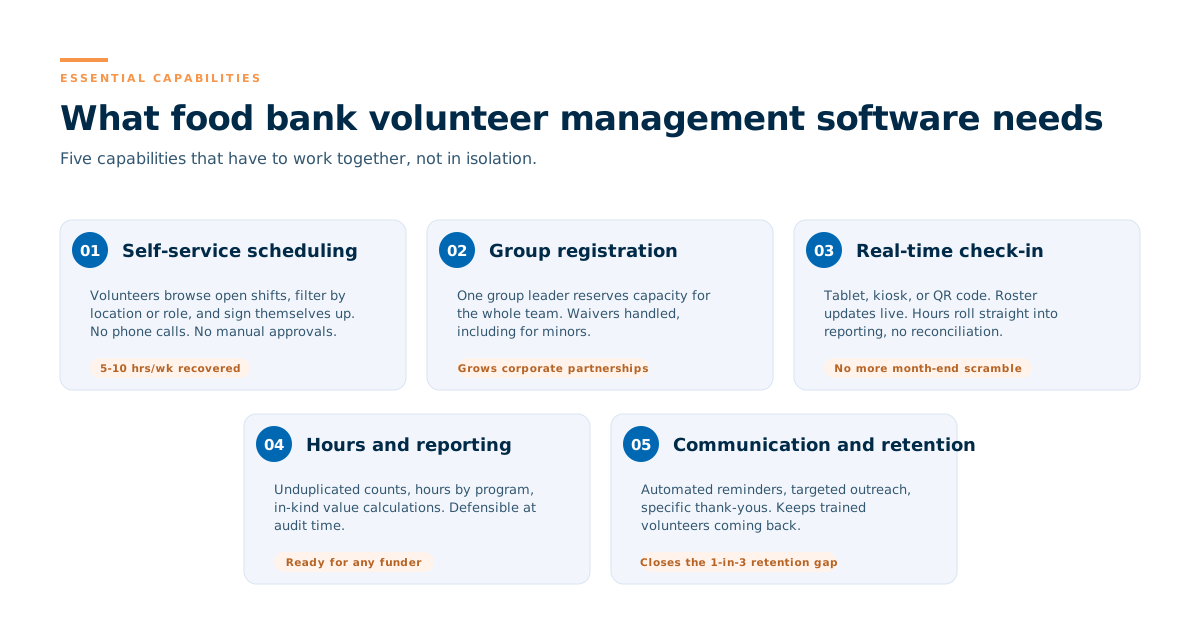
When you are evaluating volunteer management software for your food bank, five capabilities matter more than anything else. If a platform cannot handle all five, it will not hold up at scale. At the volume most food banks operate, even small inefficiencies in these areas quickly turn into missed shifts, inaccurate reporting, and added strain on your team.
Self-Service Scheduling and Sign-Up
Your volunteers should be able to browse available shifts, filter by location or role, and sign themselves up — without a phone call to the coordinator and without waiting for manual approval. This is the single biggest time saver, because it shifts shift-filling from a coordinator-led task to a volunteer-driven one.
Look for the ability to set qualifications (age, waiver on file, training completed) as sign-up requirements, waitlist management for popular shifts, and automated reminders that reduce no-show rates. The best volunteer scheduling platforms let you post a shift once and let the software handle the rest.
Group Registration
Group volunteering is where generic tools most often fall apart. Your software needs to treat a group registration as a single transaction: a group leader reserves capacity for their team, collects waivers (including for minors), and receives logistics on behalf of the whole group. The coordinator sees one registration with an accurate headcount, not 30 individual sign-ups stitched together.
If corporate partnerships, church groups, or school service days make up a meaningful share of your program, this is not a nice-to-have — it is the difference between growing those partnerships and turning them away because the sign-up process breaks down.
Real-Time Check-In
On event day, your volunteers should be able to check in from a tablet, kiosk, or QR code. Your roster should update in real time so you know immediately whether a shift is fully staffed. And the hours logged at check-in and check-out should roll directly into your reporting — no paper sign-in sheets, no manual data entry, no month-end reconciliation project that eats your coordinator's last week of the month.
Paper sign-in sheets and spreadsheets create work that scales poorly. Automated check-in removes that work entirely.
Hours Tracking and Reporting
Every completed shift should add hours to your volunteers' profiles automatically. You should be able to pull reports by volunteer, by program, by site, by date range, or by shift type — in minutes, not days.
Clean, reliable reporting is not optional. Whether you report to a parent network, a board, a city agency, or grant funders directly, you need unduplicated volunteer counts, accurate total hours, in-kind value calculations at the current Independent Sector rate, and demographic breakdowns where you collect them. The reporting capabilities in your volunteer management software directly determine how confident you can be in those numbers when a funder or auditor asks.
Volunteer Communication and Retention
Automated reminders reduce no-show rates and help volunteers feel prepared for their shifts. Targeted communications reach specific segments — everyone signed up for a Saturday shift, everyone who volunteered at a specific mobile pantry, or everyone who has not returned in 90 days. Post-shift thank-you messages that reference what a volunteer actually did carry more weight than a generic appreciation email and reinforce their connection to your mission.
First-year volunteer retention across the nonprofit sector sits around 65%, meaning roughly one in three volunteers will not return after their first experience. For food banks, where trained warehouse and distribution volunteers are hard to replace, closing that retention gap is a meaningful operational win — and the communication tools built into your volunteer management software are how you close it.

The Impact Food Banks Actually Experience with Volunteer Management Software
When food banks move from manual processes to purpose-built volunteer management software, the gains tend to show up in four areas. Those improvements are not incremental — they compound over time, reshaping how efficiently your entire food bank volunteer operation runs.
Coordinator time recovered
Self-service scheduling alone can give your coordinator back 5 to 10 hours each week. Automated check-in and hours tracking returns several more by removing repetitive administrative tasks. VolunteerHub clients report saving an average of 15 hours per week by using the platform instead of managing their programs manually. Over the course of a year, that becomes hundreds of hours redirected from administration to mission-critical program work.
Scalable program capacity
When your operations run smoothly day to day, your program can grow with confidence.
Food banks using VolunteerHub have been able to add mobile pantry sites, launch new corporate volunteer partnerships, and expand their distribution schedules without increasing headcount.
Reliable reporting
Clean hours data and unduplicated volunteer counts hold up at audit time and strengthen grant applications. Your board, funders, and network partners all receive the specific, trustworthy numbers they need to understand your program’s impact.
Stronger volunteer retention
Consistent communication, specific appreciation, and a low-friction sign-up experience keep volunteers coming back and deepening their commitment. Every retained volunteer is one you do not have to recruit and train from scratch, which protects your capacity and your team’s time.

How to Evaluate the Best Volunteer Management Software for Your Food Bank
Feature lists often look similar across vendors, so choosing the right platform usually comes down to a few practical considerations. What matters most is how the system performs in real-world conditions—handling high shift volume, managing group registrations, and meeting compliance requirements. These day-to-day demands reveal far more than feature descriptions ever will.
Ultimately, the best choice is the platform that fits your current operations and can continue to support your program as it grows.
Does the volunteer management software provider have a track record with food banks specifically?
Food banks have unique operational demands—food safety protocols, warehouse environments, surges in group volunteers, and compliance-driven reporting. Most generic volunteer management tools weren’t built with these needs in mind.
Can the platform handle your current volume, with room to grow?
A platform that fits your needs today but becomes limiting in 18 months will likely need to be replaced—more than once. Food bank programs often grow faster than expected, so evaluate solutions based on your projected needs two years out, not just your current state. Planning for that growth upfront helps you avoid repeated system changes, data migrations, and the operational disruptions that come with them.
What does implementation look like?
The first 60 to 90 days after a software transition can feel more challenging than the processes you had in place before — that is normal, and it matters that the vendor's implementation team helps you through it. Ask what the first 90 days look like, who is assigned to your account, and what training is included.
How well does the platform integrate with your donor CRM?
Volunteer-to-donor conversion is a real priority for most food banks, which means your volunteer data needs to connect cleanly to your donor database. Strong integrations with CRMs like Salesforce, Blackbaud Raiser's Edge, eTapestry, and Bloomerang are worth verifying during the evaluation.

Why Food Banks Choose VolunteerHub for Volunteer Management Software
Since 1996, VolunteerHub has helped thousands of organizations recruit, engage, and manage their volunteers, and food banks have been a core part of that work for decades. Atlanta Community Food Bank, Rhode Island Community Food Bank, Freestore Foodbank, St. Louis Area Foodbank, Food Bank of the Southern Tier, Foodbank of Southeastern Virginia, and many other food banks of every size and structure use VolunteerHub every day to run programs at scale.
The platform is built for the volume and complexity that food banks operate at:
- Group registration built for corporate teams and community partners, with streamlined waiver collection (including for minors) handled in one place
- Real-time check-in from tablets, kiosks, or mobile devices, with hours automatically captured—no paper sheets or manual data entry
- Funder-ready reporting that delivers unduplicated volunteer counts, hours by program, and in-kind value calculations in minutes, not days
- Seamless integrations with Salesforce, the full Blackbaud suite (Raiser’s Edge, eTapestry, Altru, Luminate), and thousands of other tools through Zapier
- Implementation and ongoing support from a team with decades of experience working alongside food banks—so you’re not figuring it out alone
As Jonathan James, Volunteer Program Manager at Atlanta Community Food Bank, put it: "Before investing in VolunteerHub, we used another volunteer management solution, but it didn't meet the needs of our unique program. The features VolunteerHub provides are a game-changer."
Finding the Right Volunteer Management Software Fit for Your Food Bank
The best volunteer management software for a food bank is the one that fits the scale and complexity of your program. Smaller food banks with lower shift volume may be well-served by simpler tools. Food banks running tens of thousands of volunteer hours a year, managing corporate group partnerships, and producing detailed reporting for boards and funders will see the biggest gains from a purpose-built platform.