
Orientation and onboarding serve different purposes in a volunteer program, and building both well is one of the more reliable investments a program can make in its long-term capacity.
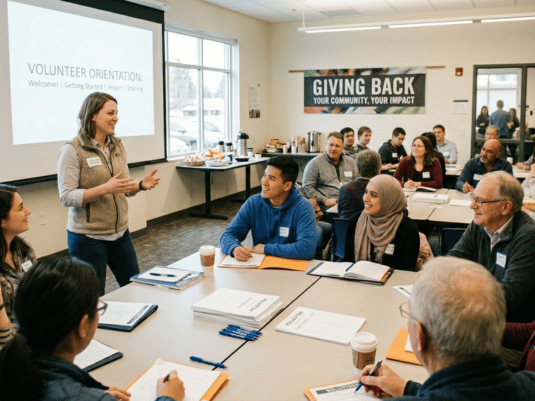
Orientation is an event. It happens once, typically before a volunteer's first shift, and its purpose is informational: here is the organization, here is the mission, here is what you will be doing and how. Done well, it gives a new volunteer the context they need to show up prepared and feel like they belong. Done poorly, it is a long presentation that volunteers forget before they reach the parking lot. Either way, it ends. The volunteer leaves, and the program's active work of building that relationship is just beginning.
Onboarding is a process. It begins before the first shift and runs through the first 60 to 90 days of a volunteer's participation. Its purpose is relational: to build the connection between the individual and the organization that determines whether they return, deepen their commitment, and eventually become the kind of volunteer who shows up reliably and brings others with them.
A well-designed volunteer program invests in both. Orientation equips new volunteers with what they need to start. Onboarding builds the relationship that makes their participation last.
What a Complete Onboarding Sequence Includes
Onboarding begins immediately after a volunteer's first shift and encompasses everything the organization does deliberately to build that volunteer's connection over the following weeks. A complete sequence has four touchpoints, each serving a specific purpose.
The 24-to-48-hour follow-up is the first and most important. A message that thanks the volunteer by name, references what they specifically did, and tells them what that contribution made possible is categorically different from a generic thank-you. The former signals that the organization recognized them as an individual. The latter treats them as interchangeable with every other participant, which is the opposite of what a retention-oriented program communicates. The coordinators we work with who consistently improve first-year retention tend to point to reliable post-event follow-up as the single change with the most measurable impact. Communication is directly linked to retention, and the first follow-up message is the most underutilized communication touchpoint in most programs.
The second-shift invitation removes the friction of re-engagement. A direct, personalized invitation to a specific upcoming shift — sent within a week or two of the first event — signals that the organization is actively interested in the volunteer's continued participation, not passively available to it.
Ongoing mission connection at each subsequent touchpoint transforms participation from transactional to committed. Follow-up messages that translate a volunteer's specific contribution into a concrete organizational outcome build the volunteer's understanding of their role as part of something ongoing. That understanding is the foundation of retention. Engaging volunteers beyond the event is what converts a one-time participant into a long-term contributor.
Role expansion opportunities give volunteers a stake in the program beyond filling slots. Surfacing pathways to more specialized roles, leadership responsibilities, or recurring shift ownership early in the relationship gives volunteers a reason to deepen their investment. Programs that introduce these options early tend to see stronger engagement over time.
Building the Sequence at Scale
A four-touchpoint onboarding process is straightforward to describe and genuinely difficult to execute at volume without systems to support it. A coordinator managing a high volume of active volunteers across multiple programs cannot manually send personalized follow-up messages within 48 hours of every event. The constraint is volume — manual follow-up at scale is not a realistic operational model, regardless of coordinator capacity.
Automated volunteer communication tied to volunteer activity — first event completed, second shift invitation, 30-day check-in — delivers the onboarding sequence reliably without requiring the coordinator to track and initiate each step. The message still reflects the organization's voice and the volunteer's actual contribution. The coordinator is not removed from the relationship. They are removed from the logistics of maintaining it.
This is where orientation and onboarding diverge in terms of operational complexity. Orientation can be delivered at scale with a single presentation or a recorded video. Onboarding is individual and sustained. It requires knowing which volunteer is in which stage of their relationship with the organization and taking the right action at the right time. Best practices for volunteer orientation are well documented; the onboarding infrastructure that follows is what makes those practices pay off over time.
What Strong First-Year Retention Makes Possible
The direct outcome of a well-executed onboarding process is a higher percentage of first-year volunteers who return for a second year and beyond. That outcome compounds in ways that are worth understanding.
Volunteers who move through their first 90 days with a clear sense of their contribution and a direct invitation to continue are more likely to increase their hours, take on recurring roles, and eventually become the dependable participants every program relies on. They also tend to bring others: volunteers who feel genuinely connected to an organization are a consistent source of peer referrals, which reduces the recruiting burden over time.
The alternative — a program that successfully recruits new volunteers each cycle but loses a significant share of them after the first shift — creates a continuous recruiting obligation that consumes coordinator capacity without building program depth. Each recruiting cycle starts from roughly the same baseline. A strong first-year retention rate converts that recruiting energy into compounding capacity instead, building a more experienced volunteer base with each passing year rather than continuously replacing it.
The 60 to 90 days after a volunteer's first shift are when that trajectory is set. Volunteers who receive consistent, personal, mission-connected communication during that window are far more likely to become the program's long-term contributors. Those who receive nothing — or only generic outreach — are far more likely to stop showing up.
How VolunteerHub Supports the Full Sequence
VolunteerHub is built to support each stage of a structured onboarding sequence without adding to the coordinator's operational workload.
On the communications side, VolunteerHub's Workflows feature handles trigger-based automation — messages that fire automatically when a defined action occurs in the system, such as a new volunteer creating an account or being added to a specific user group. For post-shift follow-up, coordinators can send a targeted email to all volunteers registered for a specific event directly from that event's record, keeping the message specific to what volunteers actually did that day without requiring a separate mailing system or manual list-building.
On the tracking side, VolunteerHub's user group structure gives coordinators a clear view of where each volunteer stands in the onboarding timeline — which volunteers are in their first 30 days, which have completed their second shift, and which have been introduced to a more specialized role. Email and reporting tools are built around these groups, so coordinators can communicate with or pull data on any segment at any stage. The participation and retention reports surface which volunteers are moving through the onboarding window as expected and which have gone quiet, giving coordinators the information they need to follow up before a new volunteer disengages entirely.
To build your program's onboarding sequence, start by mapping the touchpoints between a volunteer's first and fourth shift and assigning a purpose to each. From there, identify which steps can be systematized and which require direct coordinator attention. VolunteerHub supports both.
If you would like to see how that works for a program at your scale, we would be glad to connect.