
A well-structured volunteer onboarding process can reduce early drop-off and help new volunteers feel connected, confident, and committed from the start.
How many volunteers does your organization lose before they ever make it to a second shift?
It can be an uncomfortable question, especially when you consider how much time, planning, and care go into your volunteer recruitment strategies. Yet for most organizations, early dropout is not a motivation problem — it is an onboarding problem.
When volunteers do not feel welcomed, informed, or connected after signing up, they often step back quietly. There is rarely a clear “I am leaving” moment — just a gradual disengagement. If that pattern feels familiar, you are not alone. Early disengagement is one of the biggest barriers to building a sustainable, thriving volunteer program. And by the time you notice the drop-off, you are often starting over, launching a new recruitment effort to replace volunteers who were eager to contribute only a few weeks earlier.
The encouraging news is that a thoughtful, structured onboarding experience can change this trajectory. With the right process — and the right tools to support it, you can help new volunteers feel prepared, connected, and confident from the very beginning.
In this blog post, we will look at what the data reveals about effective onboarding and then walk through what a modern, scalable volunteer onboarding journey can look like in practice.
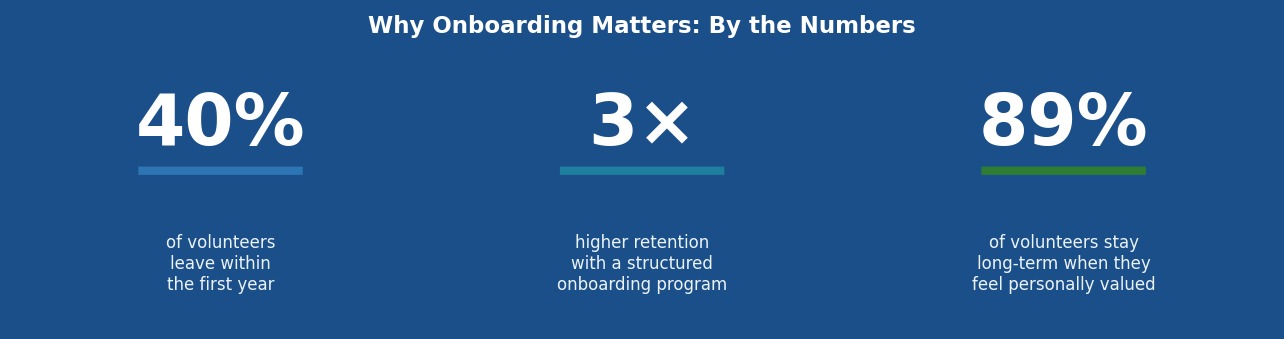
What Good Volunteer Onboarding Actually Looks Like
Before diving into specific tactics, it is helpful to step back and ask: what are we actually trying to accomplish with onboarding? It is not only about getting a volunteer up to speed on policies and procedures. Effective onboarding answers three core questions that every new volunteer is quietly asking when they first engage with your organization:
- Do I belong here?
- Does my contribution actually matter?
- Can I see myself doing this long-term?
A strong volunteer onboarding process addresses all three, not through a single presentation, but through the experience you create.
When a new volunteer receives a warm, timely, and personal welcome within 48 hours of signing up, that communicates belonging. When orientation begins with your mission and a real story of impact instead of leading with a liability waiver, that communicates meaning. When a coordinator follows up after the first shift to ask how it went and offers support, that communicates that their presence is noticed, valued, and needed.
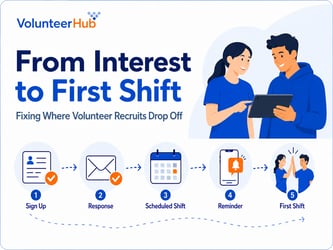
In the next section, you will see a visual overview of the full onboarding journey. Then we will break down each stage so you can design a process that is both personal for volunteers and scalable for your team.
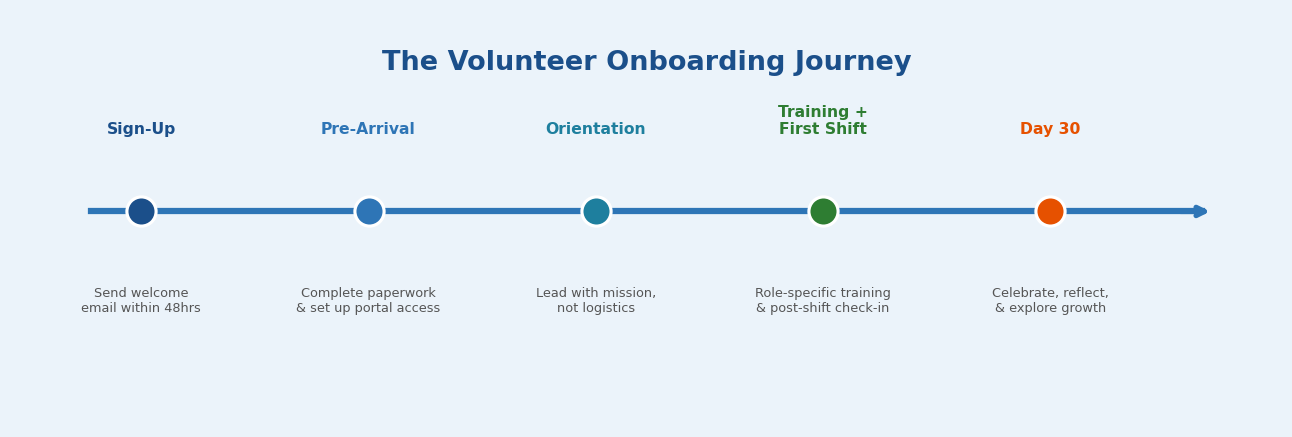
Volunteer Onboarding Starts Before Day One
Most organizations treat onboarding as a single event — an orientation session, a handbook handoff, perhaps a tour. In reality, volunteers are forming their impression of your organization from the moment they select a role and submit a registration form.
What happens in that window between sign-up and day one? For many programs, the honest answer is: very little. A confirmation email, and then silence until orientation. That silence has a cost.
Consider what it communicates. Someone has just chosen to give their time — one of their most limited resources — to your mission. They completed the form, took the step, and then heard nothing for days. It naturally raises doubts: Did anyone notice? Is this organization prepared to work with volunteers? Did I make the right decision?
The solution does not need to be complex. Within 24 to 48 hours of a volunteer signing up, they should receive a warm, personal welcome that:
- Confirms their registration
- Outlines exactly what will happen next
- Provides a specific contact person for any questions
This kind of timely, intentional outreach is one of the highest-impact investments you can make in engagement. You are not only confirming details; you are signaling that the individual behind the registration truly matters.
You can also use this pre-orientation window to complete essential steps digitally, such as waivers, emergency contacts, and background check authorizations. When volunteers arrive on day one already knowing what to expect, with required forms submitted and access to your volunteer portal confirmed, they feel prepared and confident.
And prepared volunteers are more confident volunteers.
|
Volunteers are forming their impression of your organization from the moment they hit “submit” on their registration form. |
Orientation Should Feel Like a Welcome, Not a Briefing
Here is a valuable question to ask about your current orientation experience: if you were a brand-new volunteer, would you leave feeling excited — or simply informed?
The distinction matters. Many orientations are structured around what the organization needs volunteers to know: policies, procedures, liability waivers, and system walk-throughs. All of that is important for compliance and consistency. However, when it is the first message a new volunteer receives, it can signal: here are the rules you need to follow.
What volunteers need to hear first is something different: here is why this work matters, and here is why we are glad you are part of it.
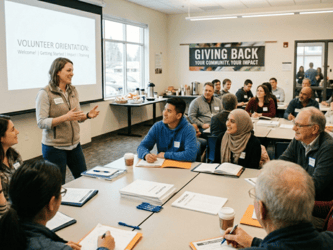
Begin with your mission. Share a specific story about someone your organization has served or an outcome your volunteers helped make possible. Allow new volunteers to understand the impact they are stepping into before you introduce a policy document or system training. If you would like a more detailed framework, our guide on building a volunteer orientation that drives retention offers 10 practical best practices you can implement quickly.
From there, an effective orientation covers the practical essentials in a clear, focused way:
- The volunteer’s specific role and why it is important
- How to use your volunteer management tools and where to find help
- Who their primary contact is
- What to expect on their first shift
Keeping orientation focused prevents information overload and helps volunteers feel confident rather than overwhelmed.
Finally, be intentional about peer connection. Volunteers who leave orientation knowing at least one other person’s name are much more likely to return for a second shift. Build in time for introductions or small-group conversations — even 10 to 15 minutes of unstructured interaction can begin to create the sense of community that sustains long-term engagement.
Training That Builds Confidence, Not Just Compliance
There’s a difference between a volunteer who has been trained and a volunteer who feels prepared. A well-designed volunteer training program isn’t about getting through material; it’s about building the kind of confidence that makes someone genuinely excited to show up.
A few principles that make the difference:
- Match the format to the role. Hands-on work requires hands-on training. A volunteer who’ll be leading a program group can’t prepare for that by reading a handbook. They need to practice, observe, and ask questions in context.
- Keep it modular. Short, focused training sessions outperform long ones every time. Break your content into chunks that volunteers can absorb without burning out — and that you can update without rebuilding everything from scratch.
- Give them something to come back to. Nobody remembers everything from training. A quick-reference guide, a short FAQ, or a well-organized digital resource page gives volunteers a safety net, and confident volunteers stay longer.
- Follow up after the first shift. The most valuable training feedback you’ll ever get comes after someone has actually done the work. A quick check-in after a volunteer’s first solo shift is worth more than hours of additional pre-shift preparation.
|
Pro tip: Send required training materials before orientation, not during. Volunteers who arrive having already reviewed the basics are ready to ask better questions — and your orientation time goes further. |
The First 30 Days Are Where Retention Is Actually Won
Orientation is complete. Training is finished. Your new volunteer has shown up for their first shift, and it went reasonably well. What happens next?
The choice to stay or step away is shaped in the weeks that follow in the consistent, small moments of connection, recognition, and follow-through that signal to a volunteer that they truly belong in your program. The first 30 days are especially important.
Use the following plan as a guide to design those touchpoints with intention.
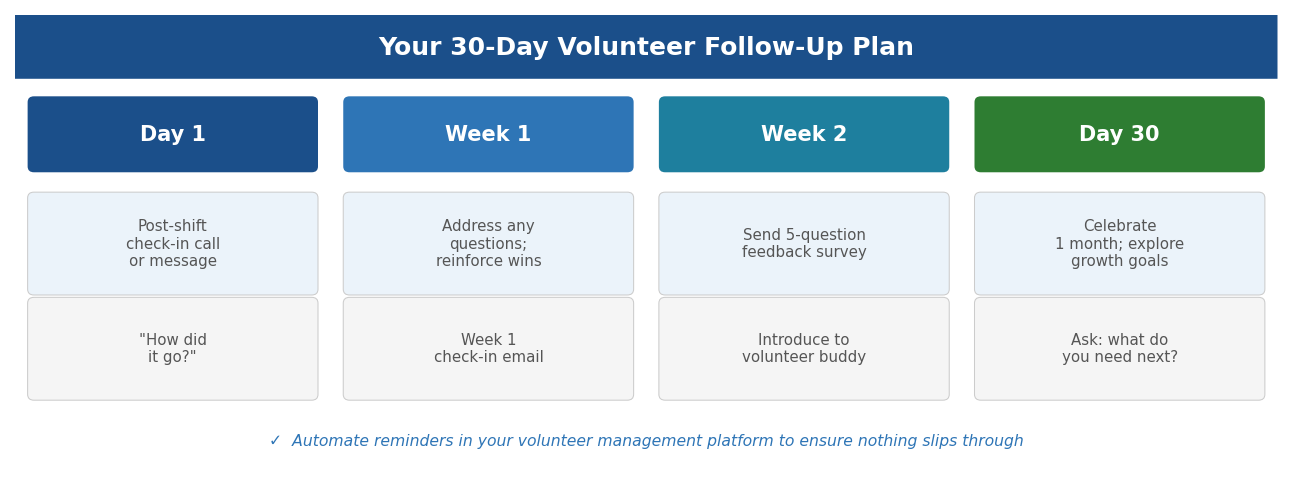
None of these touchpoints need to be elaborate. What matters is that they’re consistent and personal. A same-day check-in message after the first shift that says “How did it go?” takes 30 seconds to send. But for a new volunteer who’s wondering if anyone noticed they showed up? It can make the difference between coming back and quietly dropping off.
Beyond check-ins, the most powerful retention driver in the first 30 days is recognition. Not a generic “thank you for volunteering” blast email — a specific note that acknowledges something they actually did. “You handled that difficult situation with a client really gracefully today” communicates something that no amount of appreciation messaging can: I see you. For a deeper look at what keeps volunteers engaged beyond month one, check out our guide on
Beyond check-ins, the most powerful retention driver in the first 30 days is recognition — not a generic “thank you for volunteering” blast email, but a specific, personal note that acknowledges something they actually did. “You handled that difficult situation really gracefully today” communicates something no form letter can: I see you. For a deeper look at what drives long-term commitment, check out our guide on effective ways to retain more volunteers.
|
The decisions that determine whether a volunteer stays happen in the weeks after orientation — in the small moments of connection, recognition, and follow-through. |
The Most Common Volunteer Onboarding Mistake? Treating It Like a One-Time Event
If there’s one thing that separates high-retention volunteer programs from others, it’s this: they think of volunteer onboarding as a journey, not a single day.
A volunteer isn’t “onboarded” after they sit through an orientation. They’re onboarded when they feel confident in their role, connected to the mission, and genuinely welcomed by the people around them. That takes weeks, sometimes a full 90 days, and it requires intentional effort throughout.
The organizations that get this right build onboarding into their systems and workflows. They automate what can be automated — welcome emails, reminders, background checks, so coordinators can focus on the human moments that can’t be. They use volunteer program data to identify where people are dropping off. And they keep a close eye on early signs of volunteer fatigue and burnout before they become a retention problem.
It’s also worth revisiting your onboarding process at least once a year. What worked when your program had 50 volunteers might not scale to 250. What made sense for in-person programs may need to be rethought for a hybrid or fully remote volunteer base. Your volunteer onboarding process should grow as your program does.
How Tools Make Volunteer Onboarding Easier to Scale
Many volunteer coordinators are balancing a full workload with limited time. An effective onboarding process should not add hours of additional follow-up to your week; it should be supported by the systems you already rely on. This is where a dedicated volunteer management platform becomes essential.
The right volunteer management software can:
- Collect waiver and required form submissions
- Centralize onboarding information in one place
- Assign volunteers to the right opportunities based on qualifications
- Track volunteer attendance at orientation sessions
- Send updates if shift details or onboarding steps change
- Store important volunteer details for staff reference
- Help staff identify which volunteers are ready to serve
- Create a more consistent onboarding experience across the organization
- Reduce manual follow-up for coordinators
Automating these tasks frees your team to focus on the high-touch moments that matter most, meaningful conversations, thoughtful recognition, and relationship-building that strengthen commitment over time. As you build or refine your volunteer engagement strategy, your technology infrastructure plays an essential role in making that possible.
The goal is not to make volunteer onboarding feel automated. It is to make sure nothing important slips through the cracks, so your personal, authentic touchpoints reach volunteers at exactly the right moments.
If you want, I can also make it sound more polished, more conversational, or more nonprofit-focused.
Start Small, But Start
You do not need to redesign your entire onboarding program at once. Start with one focused change: refine the welcome message new volunteers receive within 48 hours, redesign the opening of your orientation to lead with mission, or map out a simple 30-day touchpoint plan for your next cohort.
Small, intentional improvements, repeated consistently, can transform your onboarding into a program that people talk about, one where volunteers feel valued from the moment they sign up, build genuine relationships with the people around them, and experience the work as meaningful enough to keep returning.
Ultimately, that is the purpose of onboarding: not only to orient people to your organization, but to lay the foundation for a long-term, trust-based relationship between each volunteer and your mission.
Ready to go deeper? Check out these resources:
- Volunteer Orientation That Builds Retention: 10 Best Practices
- 7 Key Elements of an Effective Volunteer Training Program
- 5 Effective Ways to Retain More Volunteers
- How to Use Data to Optimize Your Volunteer Program