

How to Conduct a Volunteer Program Capacity Assessment
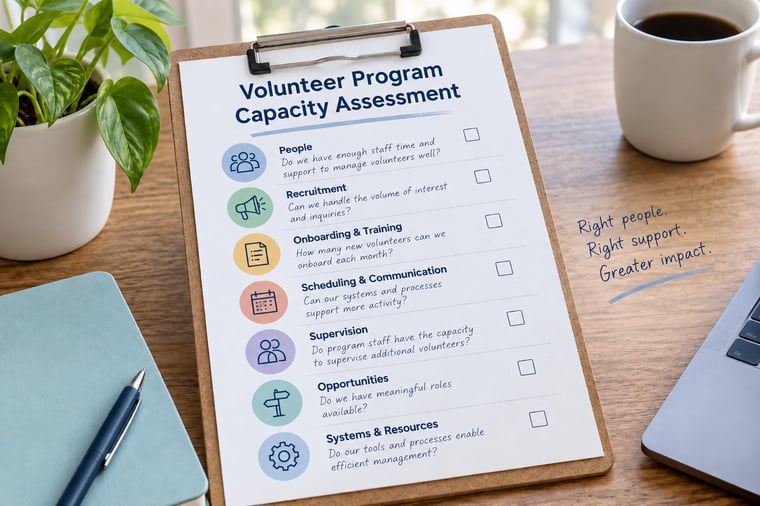
Recruiting more volunteers can increase what your organization can do, but growth always creates more work behind the scenes. Someone still has to answer questions, review registrations, provide orientation, coordinate schedules, manage cancellations, track participation, communicate updates, and make sure volunteers have meaningful work when they arrive.
That is the operational reality behind volunteer growth. Interest alone does not tell you whether your program is ready to support more people. You also need to look at how many volunteers your organization can realistically onboard, schedule, supervise, and support with the staff time and resources you have today. A volunteer program capacity assessment helps you answer that question before you set recruitment goals or expand the program.
What Is Volunteer Program Capacity?
Volunteer program capacity is the number of volunteers your organization can support without overloading staff or creating an inconsistent experience for volunteers. That number will vary based on how your program operates.
A coordinator overseeing several hundred experienced volunteers who serve independently may have far less day-to-day supervision than someone managing a smaller group that requires interviews, background checks, training, and close oversight. That is why the volunteer count alone does not tell you much. A useful capacity review looks at the work required across the full volunteer experience, from the first inquiry through ongoing participation.
Begin With Your Current Workload
Start with the work your volunteer program already demands. In a typical month, how much staff time goes to recruitment, volunteer questions, application review, scheduling shifts, training, cancellations, hour tracking, internal communication, reporting, and follow-up?
You do not need a perfect breakdown to get useful answers. A general view of where staff time goes is usually enough to show where pressure is building. A time audit for volunteer coordinators can help here. Tracking the work for a week often makes it clear which responsibilities take the most time and which ones start to slip when the workload increases.
Pay close attention to any responsibility that depends heavily on one person. A process can seem manageable until that person is out or volunteer volume starts to increase.
Review Each Stage of the Volunteer Lifecycle
Capacity constraints do not always show up in the same part of the program. One organization may have plenty of volunteer opportunities available, but struggles to keep up with new applications. Another may recruit and onboard volunteers without much trouble, but not have enough staff capacity to supervise them once they arrive.
Looking at each stage of your volunteer management process separately makes those limits easier to identify.
Recruitment
Look closely at what happens after someone expresses interest in volunteering. Are applications reviewed one by one? Are interviews part of the process? How many steps stand between initial interest and a volunteer’s first shift? Are staff following up with people who started registration but never finished?
Then estimate how many new inquiries or applications your team can realistically handle in a typical week or month without creating a backlog. Recruitment can appear successful on the surface, but it creates operational problems quickly if your staff is not prepared to respond to the people who raise their hands.
Onboarding and Training
Onboarding requirements can vary a lot from one role to another. Some volunteers may only need a basic orientation. Others may need background checks, waivers, certifications, role-specific training, or time with program staff before they can begin.
Look at how many new volunteers can realistically move through those steps each month. Then review how long people typically wait between registration and their first shift. If that timeline keeps stretching, it is usually a sign that onboarding capacity is not keeping up with recruitment.
Scheduling and Communication
More volunteers usually mean more scheduling work, especially if volunteer management is manual. Registrations, cancellations, reminders, questions, changes, and requests for help all add to the day-to-day workload your staff is already managing.
Look at which of those tasks still require direct staff involvement. If volunteers need to contact the coordinator every time they want to register, cancel, or change a shift, growth will increase administrative pressure quickly.
Self-service scheduling and automated communication can reduce part of that burden. Our article on reducing administrative work with VolunteerHub looks at several ways to streamline those processes without pulling staff out of the parts of volunteer management that still need personal attention.
Supervision
Open volunteer positions do not automatically mean you have the capacity for more volunteers. Your program also needs enough staff time to supervise the people filling those roles.
Some volunteers may need very little oversight once they are trained. Others may need staff to assign work, answer questions, provide direction throughout the shift, or stay close by while they serve. Talk with the employees who work directly with volunteers and ask how many people they can realistically supervise at one time. It is also worth asking whether additional volunteers would actually increase output or simply create more coordination.
That difference matters most in settings like events, food distributions, shelters, museums, and other environments where volunteers work side by side with staff.
Look at Where You Actually Need Volunteers
Volunteer demand is rarely spread evenly across your organization. One program may struggle to fill every shift while another keeps a waitlist. Weekend roles may be harder to staff than weekday roles, and seasonal programs may create a very different pattern from the rest of the year.
-
Look at demand by program, role, location, day, and time. As you review it, ask:
-
Which shifts regularly go unfilled?
-
Which ones fill quickly?
-
Are volunteers waiting for roles that match their interests or availability?
-
Are certain programs depending on the same small group of volunteers?
-
Are there times of year when demand changes significantly?
-
Have program staff asked for additional volunteer support?
This kind of review helps you define the real need instead of setting a broad recruitment goal that does not match the operational reality. If your program needs ten weekday drivers, recruiting fifty additional volunteers who are only available on Saturdays does not solve the problem.
Assess Volunteer Coordinator Capacity
Volunteer growth eventually affects staff workload. Look for signs that the current workload is already starting to strain the program. Responses may be slower, orientations may be booked out weeks in advance, records may fall behind, and recognition or follow-up may happen less consistently because urgent scheduling work keeps taking priority.
Those patterns tell you something important about capacity. Ask staff what becomes harder to manage during the busiest periods and what they think would happen if volunteer participation increased by 10 or 20 percent. You may find that one part of the program could absorb more volunteers while another is already close to its limit.
It is also worth looking at how much responsibility has shifted to a small group of dependable volunteers. Experienced volunteers often help train new people, answer questions, cover open shifts, and keep the program moving. That can help in the short term, but over time, it can create a different kind of capacity problem.
Review the Processes Behind the Program
Staffing is only one part of the capacity question. The way your program runs matters too. Manual or fragmented processes can take up a surprising amount of staff time, even when the work itself is routine.
Look closely at how your organization handles registration, scheduling, cancellations, communication, attendance, service hours, volunteer records, and reporting. Pay attention to work that keeps getting repeated. Staff may be entering the same information in multiple places, recreating routine messages, updating separate spreadsheets, or responding one by one to requests that could be handled through a more consistent process.
Some of that work may be necessary. Some of it may simply reflect how the program developed over time. When you improve a process, you can sometimes create more capacity without adding staff hours. Our broader guide to managing volunteers looks at several ways scheduling, communication, data, and technology can work together as your program grows.
Find the Part of the Program That Is Limiting Growth
Once you have reviewed workload, onboarding, supervision, staffing, and processes, identify the part of the program that is creating the biggest limit right now.
For one organization, that may be orientation. Staff may have room to support more volunteers in the field, but the monthly orientation session is already full. Another organization may be able to onboard people quickly, but not have enough supervision during volunteer shifts. A third may have enough staff and meaningful work available, but still spend so much time managing scheduling manually that additional volunteers would increase administrative pressure.
Write that limiting factor down as specifically as you can. Instead of saying you do not have enough capacity, define the operational constraint: “Our current orientation schedule allows us to onboard approximately 20 new volunteers each month,” or “Program staff can effectively supervise eight volunteers during this shift.”
Specific constraints are easier to solve and easier to explain to leadership.
Estimate How Much Additional Capacity You Have
A capacity assessment does not need a complicated scoring system to be useful. A few practical estimates are often enough to guide planning.
Look at how many new volunteers you can process each month, how many people you can train, how many volunteers program staff can supervise at one time, how many meaningful positions are actually available, and how much additional scheduling and communication your staff can realistically manage.
You may not end up with one perfect number, but you should come away with a realistic range. For example, your program may be able to add 50 active volunteers over the next six months and still hold up well, but struggle to onboard 50 people in the next two weeks. Timing is part of capacity.
Compare Capacity With Recruitment Goals
Once you know what your program can realistically support, compare that with the recruitment goals you are setting.
For example, your organization may want to add 150 volunteers before the holiday season, but your current onboarding process may only be able to handle 25 new volunteers each month. That gap needs to be addressed before recruitment starts. You may need to expand orientation capacity, adjust the timeline, focus on specific roles, or recruit in smaller waves.
That kind of planning does more than protect staff capacity. It also improves the volunteer experience. Someone who hears back quickly, moves through onboarding without a long delay, and finds the right opportunity is far more likely to have a strong first experience than someone who registers during a large campaign and then waits weeks for the next step.
Revisit Capacity When Conditions Change
Capacity should be reviewed periodically rather than treated as a permanent number. Staffing changes can reduce or increase it. New programs can create additional demand. Experienced volunteers may take on leadership responsibilities. Technology may reduce administrative work. Changes to training or scheduling can affect how many people the organization can support.
A review is particularly useful before a major recruitment campaign, seasonal program, new location, large event, or expansion of services. Keeping a record of previous assessments can also help show leadership how the program has changed.
If volunteer demand continues to increase while the same constraint appears year after year, the organization has stronger evidence for additional staffing, technology, training resources, or another investment.
How VolunteerHub Can Help Increase Volunteer Program Capacity
For some organizations, one of the biggest limits on capacity is the amount of staff time spent on routine administrative work.
VolunteerHub can help reduce that workload by bringing volunteer registration, scheduling, communication, hour tracking, and volunteer records into the same system. Volunteers can find and register for opportunities without staff processing every request, while automated emails and workflows can handle routine confirmations, reminders, and follow-up communication.
User Groups and filtering can help staff organize volunteers by program, role, location, or other criteria and communicate with specific groups without maintaining separate contact lists. Centralized volunteer records can also reduce the need to manage information across multiple spreadsheets or systems.
These efficiencies can give volunteer coordinators more time for the work that requires direct staff involvement, including onboarding, supervision, volunteer support, relationship-building, and program planning. For organizations trying to increase capacity without adding the same amount of administrative work, that can make a meaningful difference.
If you would like to see how VolunteerHub can support the growth of your volunteer program, request a demo.
Using Your Capacity Assessment
A completed assessment should give you a clearer picture of where the program has room to grow and where additional pressure would create problems. You may decide that the organization is ready to recruit more volunteers, that a specific process needs attention first, or that certain programs can expand while others should remain at their current size.
Volunteer programs work best when staff have enough time to communicate clearly, provide appropriate supervision, and give people meaningful work. Reviewing capacity before increasing recruitment can help preserve those conditions as participation grows.