


When your program is short on volunteers, recruitment often feels like the most logical place to start. You post open opportunities, share them across social channels, and include a note in your newsletter. But if you have ever welcomed a group of enthusiastic new volunteers only to watch many of them disengage within a month, you have likely seen the real challenge: the issue is rarely recruitment alone. It is the experience volunteers encounter after they raise their hands.
Volunteer recruitment preparation is the intentional work your organization completes before making the first ask. It determines how much of your recruiting effort translates into lasting participation. Strong preparation helps protect your team’s time, reduces operational strain, and gives new volunteers a clear, organized path to meaningful contribution.
This post outlines six elements to have in place before you begin recruiting, presented in a practical build order. It also includes a quick go/no-go check you can complete in ten minutes. For organizations mapping the broader volunteer lifecycle, our Ultimate Guide to Volunteer Management explores each stage in greater depth, while our volunteer recruitment overview focuses specifically on outreach and sourcing strategies.
Why Volunteer Recruitment Success Depends on Preparation
The volunteer pool remains both real and substantial. AmeriCorps reports that 28.3 percent of American adults—approximately 75.7 million people—volunteer through an organization. Their time also carries significant value: Independent Sector valued a volunteer hour at $36.14 as of April 2026.
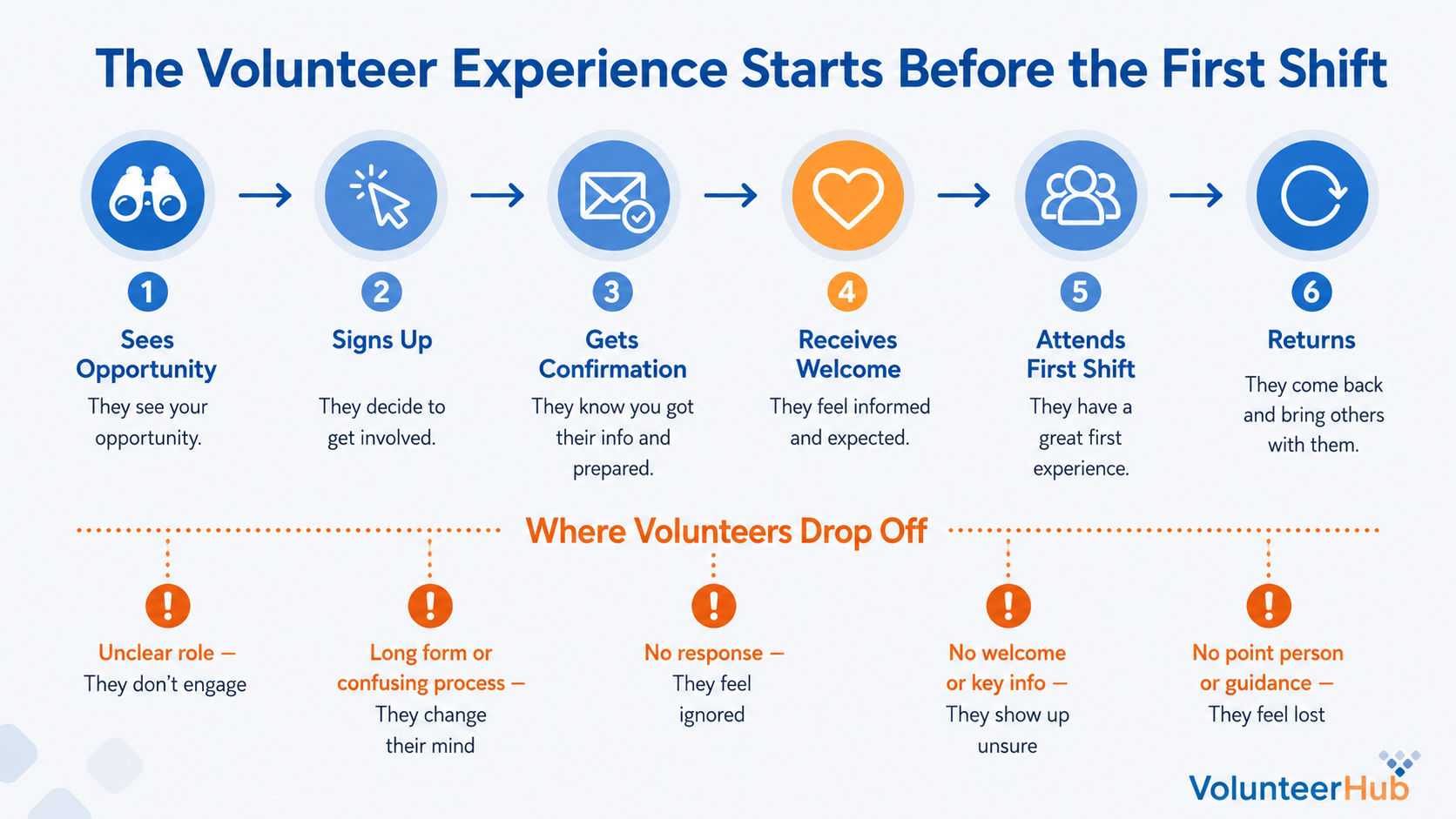
However, interest alone does not withstand a disorganized experience. When a volunteer signs up and then hears nothing for two weeks, or arrives for a shift only to discover no one was expecting them, they are unlikely to offer a second chance. At the same time, your team absorbs the full cost of that churn. Recruiting, partially onboarding, and then replacing volunteers for the same roles becomes a quiet operational drain and contributes to the burnout the Center for Effective Philanthropy has documented across the nonprofit sector.
Thoughtful preparation helps interrupt that cycle. It ensures that when someone raises their hand to help, your organization is ready to respond with clarity, structure, and a volunteer experience worth returning to. In practical terms, preparation is how you stop paying for the same volunteer need twice and begin building a more stable, sustainable volunteer program.
How to Prepare Before Recruiting Volunteers
Each step builds on the one before it, which is why the order matters. Role clarity informs capacity planning, capacity planning shapes the sign-up process, and each decision creates the foundation for the next.
Write the Role Description Before the Ask
Every recruitment message you send is ultimately a summary of the role you need to fill. If that role has not been clearly defined, the message will shift from one channel to the next, and the volunteers who respond may each arrive with a different understanding of what they agreed to do.
Before you begin recruiting, every open volunteer role should clearly answer, in writing, a core set of questions: What will the volunteer do? How much time is required and on what schedule? Where will the work take place? What does success look like? Are there any requirements, such as training, a minimum age, or a background check? A vague role description may be intended to signal flexibility, but to a prospective volunteer, it often reads as disorganized. Our guide to writing a strong volunteer opportunity description offers additional structure and sample language you can adapt to your program.
It is also helpful to apply a purpose test. A Deloitte survey found that 74 percent of working professionals say volunteering gives them an improved sense of purpose. Your role description should make the connection between the task and your mission explicit. A volunteer sorting donations is not simply completing an operational task; they are helping a household access what they need this week. That connection belongs in the role description itself, not only in your broader organizational messaging.
Confirm Your Capacity Before You Recruit
This is the step many programs overlook, and it is often where recruitment gains become retention losses. Before you begin recruiting, answer three questions honestly.
First, who will supervise them? Every new volunteer needs a clearly identified point of contact who knows they are coming, welcomes them, and can answer questions during their first shift. If your event leads or staff members are already stretched thin, adding ten new volunteers may create more strain rather than more capacity.
Second, how many volunteers can you realistically support? Set a defined number for each role. “As many as possible” often leads to more volunteers than the team can properly supervise, which can leave people idle or unsure of how to contribute. Volunteers who feel unused or unneeded are less likely to return.
Third, is the staff aligned? Volunteers can often tell within one shift whether staff views them as partners or as interruptions. If a department has not agreed on why volunteers are being added, what they will do, and how they will be supported, resolve that before expanding recruitment.
If any of these answers are uncertain, pause recruitment and address the gap first. A smaller, well-supported group of volunteers will almost always create better results than a larger group that your team is not prepared to manage.
Make the Sign-Up Process Clear and Easy to Complete
The sign-up process is where many interested volunteers drop off. Every unnecessary field, unclear next step, or dead-end page creates friction for people who were ready to help. Before you begin recruiting, walk through the process yourself as if you were a first-time visitor. Find the opportunity, register on mobile, and note every point where the experience feels unclear, slow, or incomplete.
An effective sign-up path has three important qualities. It is concise, asking only for the information needed before a first shift. It is specific, showing real roles, dates, and expectations rather than relying on a general “get involved” form. And it confirms immediately, so the volunteer knows their registration was successful and understands what happens next.
Draft the First-Touch Communications in Advance
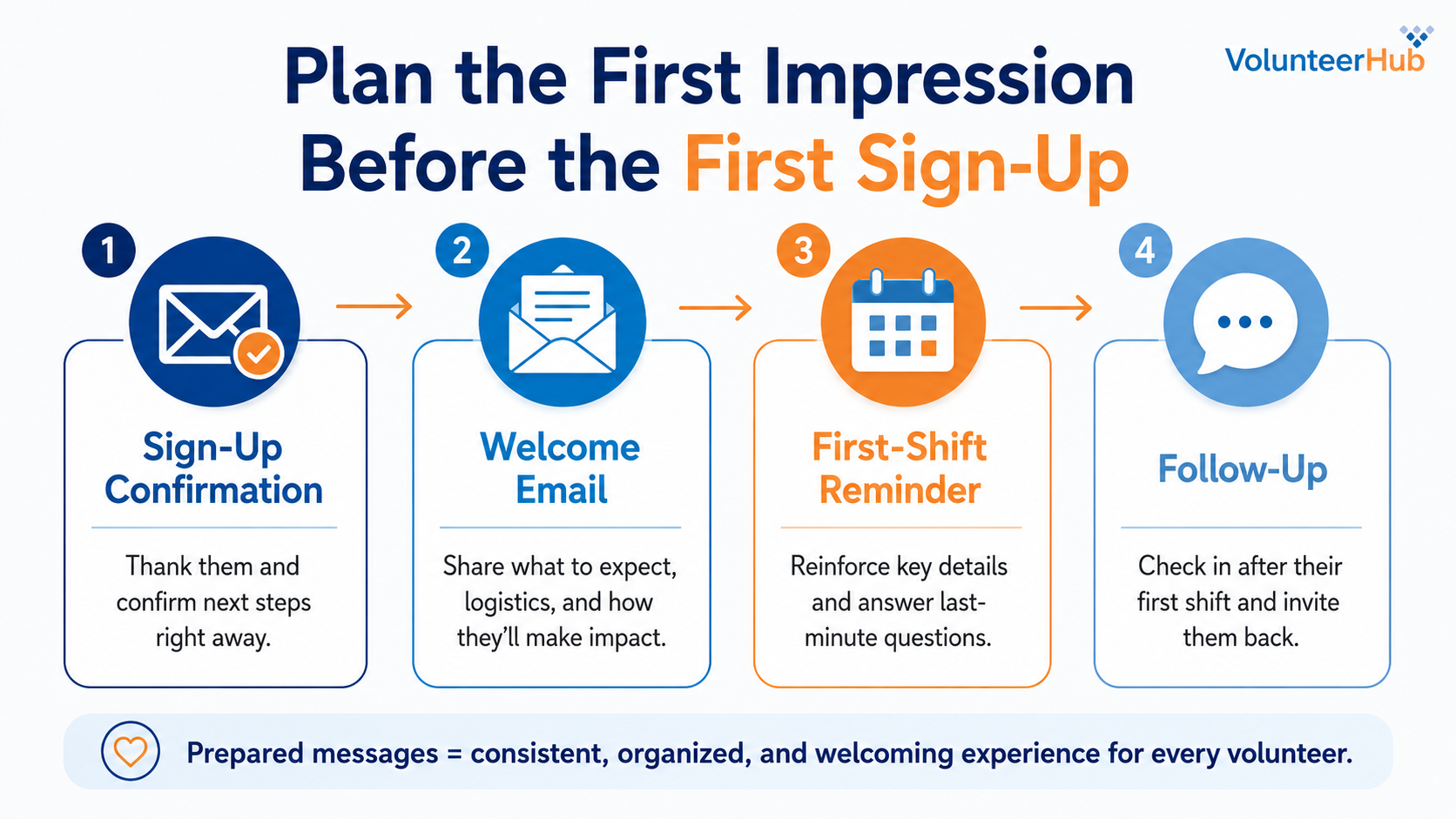
A new volunteer’s first email sets the tone for every message that follows. These communications should be written before recruitment begins, not the night before your first new volunteer arrives. At minimum, prepare the sign-up confirmation, a welcome message that explains what happens next and who to contact, and a reminder that goes out before the volunteer’s first shift.
When these messages are written and scheduled in advance, your first impression stays consistent even during busy weeks. Pair each message with a clear next step in the onboarding process so new volunteers are not left wondering what to do after they sign up.
Align the Team Responsible for Recruitment
Volunteer recruitment touches everyone who will welcome, support, or communicate with new volunteers, so it should not be planned in isolation. Before active recruiting begins, bring together the staff members who will supervise the roles, the person responsible for communications, and one or two current volunteers who can describe what truly motivated them to get involved.
Current volunteers are especially valuable at this stage. Ask what encouraged them to complete the sign-up, what almost caused them to stop, and what would have made the process clearer. Their perspective can help you strengthen your recruitment messages, simplify the experience, and remove barriers before you invite additional people into the program.
This does not need to become a formal committee. For a small program, it may be as simple as three people and one focused meeting. The goal is alignment: the people responsible for outcomes agree on which roles you are recruiting for, how many volunteers you need, and who owns each part of the recruitment and onboarding process.
Set the Strategy and Choose Your Recruitment Channels
Only after your roles are clearly defined, your capacity is confirmed, and your sign-up process is ready does channel planning become truly effective. At this stage, decide who your ideal volunteers are, where they are most likely to engage, and what message will resonate with them. Re-engaging past donors or lapsed volunteers calls for a different approach than connecting with students, corporate groups, or people who are discovering your organization for the first time.
This is the moment when preparation turns into execution, and it merits a focused plan. Our walkthrough on creating a step-by-step volunteer recruitment plan continues from this point, and our list of 17 volunteer recruitment strategies can help you select the right tactics once your program is ready to begin outreach.
Volunteer Recruitment Readiness Check
Before you post a single opportunity, take ten minutes to walk through five questions:
-
Can you describe each open role in one clear sentence that includes its impact?
-
Is there a named person responsible for greeting and supervising new volunteers during their first shift?
-
Can a volunteer sign up for a role on their phone in under three minutes and receive an immediate confirmation?
-
Is the welcome email already written and ready to send?
-
Do you know how many new volunteers each role can realistically support this month?
If you can answer yes to all five, you are ready to recruit with confidence. If one or two answers are no, you are close; address those specific gaps before you begin outreach. If three or more answers are no, recruiting now is likely to generate more churn than capacity. In that case, the most supportive step you can take—for your team and your future volunteers—is to strengthen the experience first and invite people in once it is ready.
Where Recruitment Gets Stuck
Recruiting to fill a general need instead of a defined role.
When programs are understaffed, it can be tempting to recruit for “help” broadly. But general calls for help often attract volunteers without giving the organization a clear plan for how to use their time. The role description step is designed to prevent this by defining exactly what support is needed before recruitment begins.
Treating the sign-up form like a full application.
Long forms may feel thorough, but every additional field creates another point where an interested volunteer can drop off. Focus on collecting the information needed to move someone toward their first shift, then gather additional details during onboarding when appropriate.
Assuming someone owns the welcome experience.
In many programs, the confirmation email, first-shift greeting, and follow-up process are not clearly assigned to one person. That can leave new volunteers with an inconsistent or incomplete first impression. Assign ownership to specific people, not just departments, so each part of the welcome experience is covered.
How VolunteerHub Supports Volunteer Recruitment
VolunteerHub has helped nonprofits recruit, engage, and manage volunteers since 1996. Many of the preparation steps outlined above connect directly to the platform’s core capabilities.
Branded landing pages give each program, location, or initiative its own sign-up path, helping volunteers find real opportunities with real dates instead of relying on a generic interest form.
Configurable forms allow organizations to collect the information they need at sign-up without adding unnecessary friction to the process.
User groups help route new volunteers to the right roles, events, and permissions from the moment they join.
Workflows support timely first-touch communication by automatically sending messages based on volunteer activity, including emails triggered when a new volunteer account is created. VolunteerHub also confirms registrations automatically, helping ensure new volunteers know their sign-up was successful.
CRM integrations with Raiser’s Edge, eTapestry, Altru, and Salesforce help keep volunteer records connected to donor and constituent data. Zapier is also available for organizations that need to connect VolunteerHub with other systems.
Frequently Asked Questions
What is volunteer recruitment preparation? Volunteer recruitment preparation is the work an organization completes before actively recruiting: writing role descriptions, confirming supervision capacity, building the sign-up path, drafting first-touch communications, assembling the team, and setting the outreach strategy. It ensures the volunteers you attract have a clear role and a good first experience waiting for them.
How do you prepare a nonprofit for volunteer recruitment? Work through six steps in order: write a description for every open role, confirm who will supervise new volunteers and how many you can absorb, build and test a short sign-up path, write the confirmation and welcome messages in advance, gather the staff and volunteers who own recruitment, and then choose your channels and messaging.
How do you know if your organization is ready to recruit volunteers? Run a quick go/no-go check: every role described in one sentence with its impact, a named supervisor for new volunteers, a sign-up that takes under three minutes on a phone, a welcome email already written, and a real number for how many volunteers each role can take. If most answers are no, build first and recruit after.
Why do new volunteers quit so quickly after being recruited? Early drop-off usually traces to the gap between sign-up and a good first shift: unclear roles, silence after registration, or arriving to find nobody expected them. Preparation closes that gap, and a structured onboarding process keeps it closed.
How many volunteers should you recruit at once? Recruit to your supervision capacity, not to your wish list. Set a number per role based on who can greet, train, and support new volunteers on their first shifts. A smaller cohort that gets attention retains far better than a large one that does not.
What's the best software for volunteer recruitment? Look for platforms that combine branded sign-up pages, configurable registration forms, automated confirmation and welcome messaging, and reporting on where recruits drop off. Our guides to the best volunteer management software and the top volunteer management solutions for nonprofits compare the options.